Fw::Buffer Serializable / Fw::BufferGet Port / Fw::BufferSend Port
1 Introduction
This module provides the following elements:
- A type
Fw::Bufferrepresenting a wrapper around a variable-size buffer. This allows for passing a reference to the allocated memory around without a copy. Typically the memory is allocated in a buffer manager or similar component but this is not required. -
A port
Fw::BufferGetfor requesting a buffer of typeFw::Bufferfrom aBufferManagerand similar components. -
A port
Fw::BufferSendfor sending a buffer of typeFw::Bufferfrom one component to another.
2 Design
The Fw::Buffer type wraps a pointer to memory and the size of that memory region. Thus, allowing users to pass the
pointer and size around as a pair without incurring a copy of the data at each step. Note: Fw::Buffer is not safe
to pass outside a given address space.
2.1 The Type Fw::Buffer
Fw::Buffer is a serializable class defining the following (private) fields. These fields are accessed through accessor functions.
| Name | Type | Accessors | Purpose |
|---|---|---|---|
m_bufferData |
U8* |
getOriginalData() |
Pointer to the original allocation wrapped by this buffer |
m_offset |
FwSizeType |
getOffset()/setData()/advance() |
Offset of the current data within the original allocation; getData() returns m_bufferData + m_offset |
m_size |
FwSizeType |
getSize()/setSize() |
Size of the data region currently represented by this buffer |
m_capacity |
FwSizeType |
getCapacity() |
Size of the original allocation; set on construction or set() |
m_context |
U32 |
getContext()/setContext() |
Context of buffer's origin. Used to track buffers created by BufferManager |
A value B of type Fw::Buffer is valid if m_bufferData != nullptr and
m_size > 0; otherwise it is invalid.
The interface function isValid reports whether a buffer is valid.
Calling this function on a buffer B returns true if B is valid, otherwise false.
If a buffer B is invalid, then the pointer returned by B .getData() and the
serialization interfaces returned by
B .getSerializer() and B .getDeserializer() are considered invalid and should not be used.
2.1.1 Original Pointer, Offset, and Capacity
Fw::Buffer stores its original allocation pointer plus an offset rather than allowing raw manipulation of the data
pointer. This contract guarantees that the original allocation pointer is always recoverable via getOriginalData(),
regardless of how much downstream consumers have advanced into the buffer. Components that must re-identify a buffer
when ownership is returned (e.g. a buffer manager reclaiming an allocation) may therefore key on getOriginalData().
The following contractual expectations apply:
- Constructing a buffer with
Fw::Buffer(data, size, context)or callingset(data, size, context)establishes a new original allocation: the offset is reset to0and the capacity is set tosize. advance(amount)moves the offset forward (positive) or backward (negative) and updates the size such that the end of the represented data is unchanged. Consuming leading bytes (e.g. a frame header) must be done withadvance(). An assertion fails if the resulting offset falls outside[0, capacity]or the resulting size would be negative.setData(pointer)requires the supplied pointer to lie within the original allocation ([getOriginalData(), getOriginalData() + getCapacity()]); the offset is updated accordingly. An assertion fails for a pointer outside the original allocation. To wrap unrelated memory, construct a newFw::Bufferor callset()— reusing an existing buffer for unrelated memory viasetData()is not permitted.setSize(size)requiresgetOffset() + size <= getCapacity(); an assertion fails otherwise.- Serialization (
serializeTo/deserializeFrom) carries the original pointer, offset, and capacity so that provenance survives transfer across ports.
2.2 The Port Fw::BufferGet
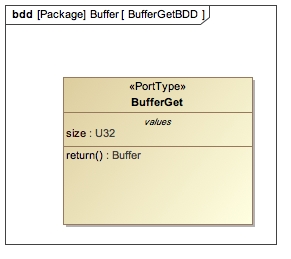
As shown in the following diagram, Fw::BufferGet has one argument size of type U32. It returns a value of type
Fw::Buffer. The returned Fw::Buffer must be checked for validity before using.
2.3 The Port Fw::BufferSend
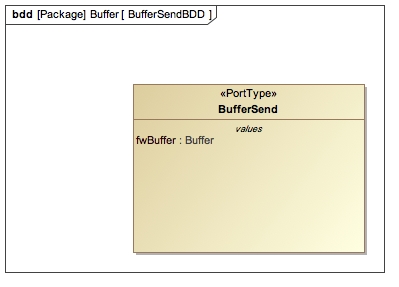
As shown in the following diagram, Fw::BufferSend has one argument fwBuffer of type Fw::Buffer.
3 Usage Notes
Components allocating Fw::Buffer objects may use the m_context field at their discretion. This field is typically
used to track the origin of the buffer for eventual allocation.
When a component fails to allocate memory, it must set
the m_bufferData field to nullptr and/or set the m_size field to zero to indicate that the buffer is invalid.
A receiver of an Fw::Buffer object B must check that B is valid before accessing the
data stored in B.
To check validity, you can call the interface function isValid().
Serializing and Deserializing with Fw::Buffer
Users can obtain a serialization buffer, sb, by calling either getSerializer() or getDeserializer().
Note that both of these methods return a Fw::ExternalSerializeBufferWithMemberCopy object that is meant to be
managed by the caller and only affects the data of the underlying buffer.
Serializing to Fw::Buffer
U32 my_data = 10001;
U8  my_byte = 2;
auto sb = my_fw_buffer.getSerializer();
// Defaults to big-endian
sb.serializeFrom(my_data);
sb.serializeFrom(my_byte);
// Or for little-endian
sb.serializeFrom(my_data, Fw::Endianness::LITTLE);
sb.serializeFrom(my_byte, Fw::Endianness::LITTLE);
Deserializing from Fw::Buffer
U32 my_data = 0;
U8  my_byte = 0;
auto sb = my_fw_buffer.getDeserializer();
// Defaults to big-endian
sb.deserializeTo(my_data);
sb.deserializeTo(my_byte);
// Or for little-endian
sb.deserializeTo(my_data, Fw::Endianness::LITTLE);
sb.deserializeTo(my_byte, Fw::Endianness::LITTLE);
The objects returned by getSerializer() and getDeserializer() implement the Fw::SerialBufferBase interface. This
allows them to be passed directly to Fw::Serializable::serializeTo and Fw::Serializable::deserializeFrom on
user-defined serializable types.