Svc::CmdDispatcher Component
1. Introduction
The Svc::CmdDispatcher is responsible for dispatching incoming commands to the components that implement those commands. The commands are sent in encoded Fw::Com form from an external sender like a ground system or a sequencer. The dispatcher decodes the packet and extracts the opcode. This opcode is looked up in a table and dispatched to the component via a port indicated in the table. The output port for each opcode is set by a call to a registration port.
2. Requirements
The requirements for Svc::CmdDispatcher are as follows:
| Requirement | Description | Verification Method |
|---|---|---|
| CD-001 | The Svc::CmdDispatcher component shall accept command buffers and decode them into commands |
Inspection, Unit Test |
| CD-002 | The Svc::CmdDispatcher component shall dispatch commands to components |
Unit Test |
| CD-003 | The Svc::CmdDispatcher component shall provide an interface to register commands |
Inspection |
| CD-004 | The Svc::CmdDispatcher component shall process command status from components and report the results to the command buffer sender. |
Unit Test |
| CD-005 | The Svc::CmdDispatcher component shall drop incoming commands to avert a queue overflow (DOS attack). |
Unit Test |
| CD-006 | The Svc::CmdDispatcher component shall count every dropped command, including drops occurring concurrently on multiple caller threads, and report the count in the CommandsDropped telemetry channel. |
Unit Test |
| CD-007 | The Svc::CmdDispatcher component shall not dispatch a command that it cannot track in the pending command table, unless configured to do so, in which case it shall dispatch the command and report that the command is untracked. |
Unit Test |
3. Design
3.1 Context
3.1.1 Component Diagram
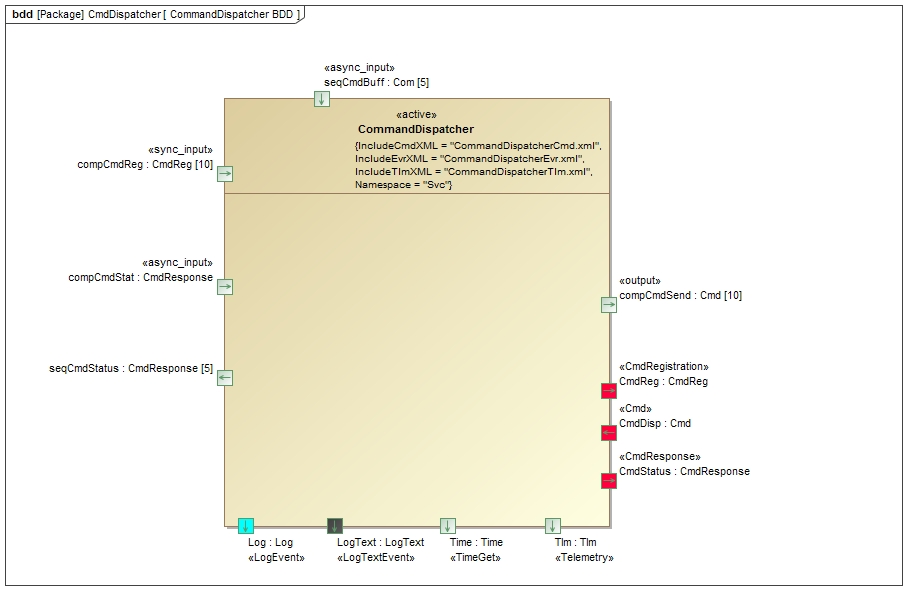
The Svc::CmdDispatcher component has the following component diagram:
3.1.2 Ports
The Svc::CmdDispatcher component uses the following port types:
| Port Data Type | Name | Direction | Kind | Usage |
|---|---|---|---|---|
Fw::Cmd |
compCmdSend | Output | n/a | Send commands to components |
Fw::CmdResponse |
compCmdStat | Input | Asynchronous | Port for components to report command status |
Fw::CmdResponse |
seqCmdStatus | Output | n/a | Send command status to command buffer source |
Fw::Com |
seqCmdBuff | Input | Asynchronous (hook overflow behavior) |
Receive command buffer |
Fw::CmdReg |
compCmdReg | Input | Guarded | Command Registration |
Svc::Ping |
pingIn | Input | Asynchronous | Ping input from health checker |
Svc::Ping |
pingOut | Output | n/a | Ping response to health checker |
Svc::Sched |
run | Input | Asynchronous | Report telemetry |
3.2 Functional Description
The Svc::CmdDispatcher component provides command dispatching. The architecture autocoder generates port instances for components that specify commands that implement the commanding pattern. Svc::CommandDispatcher implements the command decoding and dispatching to supply the components with commands.
3.2.1 Command Registration
An autogenerated function on components create a public function regCommands that tells components to register the set of op codes that are implemented by the component. The autogenerated port is connected to the compCmdReg input port on Svc::CmdDispatcher that corresponds to the number of the compCmdSend port used to dispatch commands. The port handler inserts the opcode into a dispatch table (a red-black tree map keyed by opcode), mapping the opcode to the dispatch port number corresponding to the registration port number. Re-registering an already-registered opcode is accepted and emits an OpCodeReregistered diagnostic event.
3.2.2 Command Dispatch
When the command dispatcher receives a command buffer, it decodes the opcode. It searches the dispatch table for the opcode, then assigns a sequence number to the command and stores the opcode, sequence number, context value and source port in a pending command table. The command is then dispatched to the component that implements the command. When the component completes execution of the command, it reports the status back via the compCmdStat port. The sequence number is matched to the entry in the pending command table, and the seqCmdStatus output port corresponding to the source port is called (if it is connected) with the status and the context value.
Note #1: this requires that the component sending the command buffer have connections to the same seqCmdBuff and seqCmdStatus port numbers.
Note #2: the seqCmdStatus port utilize the same type as the compCmdStat, the Fw::CmdResponse. This has been done to avoid creation of similar types for status ports. However, the Fw::CmdResponse::cmdSeq argument of the seqCmdStatus doesn't have any meaning for the calling sequencer. Therefore, as it has been mentioned before, instead of forwarding a command sequence number, the context value is transferred.
Note #3: the CMD_CLEAR_TRACKING command empties the pending command table. Before doing so, every pending command (other than CMD_CLEAR_TRACKING itself) is reported to its source via seqCmdStatus with the Fw::CmdResponse::CLEARED status, so callers do not wait indefinitely for a completion that will never be delivered. CMD_CLEAR_TRACKING then completes with Fw::CmdResponse::OK.
Note #4: sequence numbers are assigned from a monotonically increasing U32 counter. Once the counter has wrapped around, the dispatcher checks the pending command table before assigning a sequence number and skips any value still associated with an outstanding command, so a wrapped counter cannot overwrite a pending entry. No such check is performed before the first wraparound, since a monotonic counter cannot collide with a pending entry.
Note #5: the pending sequence command table is a fixed-size table (CMD_DISPATCHER_SEQUENCER_TABLE_SIZE), and it is only consulted when the seqCmdStatus output port for the calling port is connected. When a command arrives, that port is connected, and the table is full, the dispatcher's behavior is selected by CommandDispatcherImpl::configure(bool), which defaults to Svc::CmdDispatcherCfg::EXECUTE_WHEN_SEQUENCE_TABLE_FULL_DEFAULT. When false (the default), the command is not dispatched: a TooManyCommands warning is emitted and the caller receives Fw::CmdResponse::EXECUTION_ERROR. When true, the command is dispatched, a TooManyCommands warning is emitted, and the caller receives Fw::CmdResponse::DISPATCHED_UNTRACKED, indicating that the command is executing but that its completion status cannot be matched back to the caller and will never be reported. Note that the stock sequencers do not treat DISPATCHED_UNTRACKED as success: Svc::CmdSequencer fails and cancels the sequence on any non-OK response, Svc::WasmSequencer counts it as a failed command, and Svc::FpySequencer pushes the raw response value for the sequence to branch on.
3.3 Scenarios
3.3.1 Command Registration
The Svc::CmdDispatcher component accepts command registration from other components:
sequenceDiagram
    Initialization->>Component: get_ComdReg_InputPort()
    activate Initialization
    deactivate Initialization
    activate Component
    deactivate Component
    Initialization->>Component: regCommands()
    activate Initialization
    activate Component
    loop for each opcode
        Component->>CommandDispatcher: cmdReg()
    end
    deactivate Initialization
    deactivate Component
3.3.1 Dispatch Commands
The Svc::CmdDispatcher component dispatches commands to other components:
sequenceDiagram
    Command Buffer Source->>CommandDispatcher: seqCmdBuff()
    activate Command Buffer Source
    activate CommandDispatcher
    CommandDispatcher->>Component: seqCmdBuff()
    activate Component
    Component->>CommandDispatcher: compCmdStat()
    deactivate Component
    CommandDispatcher->>Command Buffer Source: seqCmdStatus()
    deactivate CommandDispatcher
    deactivate Command Buffer Source
3.4 State
Svc::CmdDispatcher has no state machines.
The dropped-command counter backing the CommandsDropped channel is incremented by the seqCmdBuff overflow hook, which runs on the thread of each caller when the queue is full. The counter is therefore an atomic (std::atomic<U32>) so concurrent drops are never lost and the value read by run is never torn.
3.5 Algorithms
Svc::CmdDispatcher has no significant algorithms.
3.6 Configuration
CommandDispatcherImplCfg.hpp provides the following compile-time settings:
| Constant | Description |
|---|---|
CMD_DISPATCHER_DISPATCH_TABLE_SIZE |
The size of the table holding opcodes to dispatch. |
CMD_DISPATCHER_SEQUENCER_TABLE_SIZE |
The size of the pending command table holding commands in progress. |
Svc::CmdDispatcherCfg::IncludeCommandOpcodesInEvents |
When false, events containing command opcodes remain enabled, but their opcode fields are set to the maximum FwOpcodeType value. Default: true. |
Svc::CmdDispatcherCfg::EXECUTE_WHEN_SEQUENCE_TABLE_FULL_DEFAULT |
Default behavior when a command cannot be tracked because the pending sequence command table is full; overridden per instance by CommandDispatcherImpl::configure(bool). See Note #5 in section 3.2.2. Default: false. |
4. Module Checklists
| Checklist |
|---|
| Design |
| Code |
| Unit Test |
5. Unit Testing
To see unit test coverage run fprime-util check --coverage
6. Change Log
| Date | Description |
|---|---|
| 6/25/2015 | Design review edits |
| 7/22/2015 | Design review actions |
| 9/16/2015 | Unit Test additions |
| 1/28/2016 | Added context value discussion |
| 5/17/2021 | Added CMD Reregistration option |
| 5/05/2025 | Added a note about Fw::CmdResponse::cmdSeq usage in seqCmdStatus |
| 9/03/2026 | CMD_CLEAR_TRACKING reports Fw::CmdResponse::CLEARED to callers of pending commands |
| 9/03/2026 | Added a note about sequence number allocation after wraparound |
| 9/14/2026 | Dropped-command counter made atomic; added CD-006 |
| 9/20/2026 | Added EXECUTE_WHEN_SEQUENCE_TABLE_FULL_DEFAULT, configure(), and Fw::CmdResponse::DISPATCHED_UNTRACKED; added CD-007 and section 3.6 |