Communication Adapter Interface
Any communication component (e.g. a radio component) that is intended for use with the standard F´ uplink and downlink
stack should implement the Communication Adapter Interface Com.fpp. This interface specifies both the ports and protocols used
to operate with the standard F´ uplink and downlink components.
Implementors of this interface are referred to as Communication Adapters.
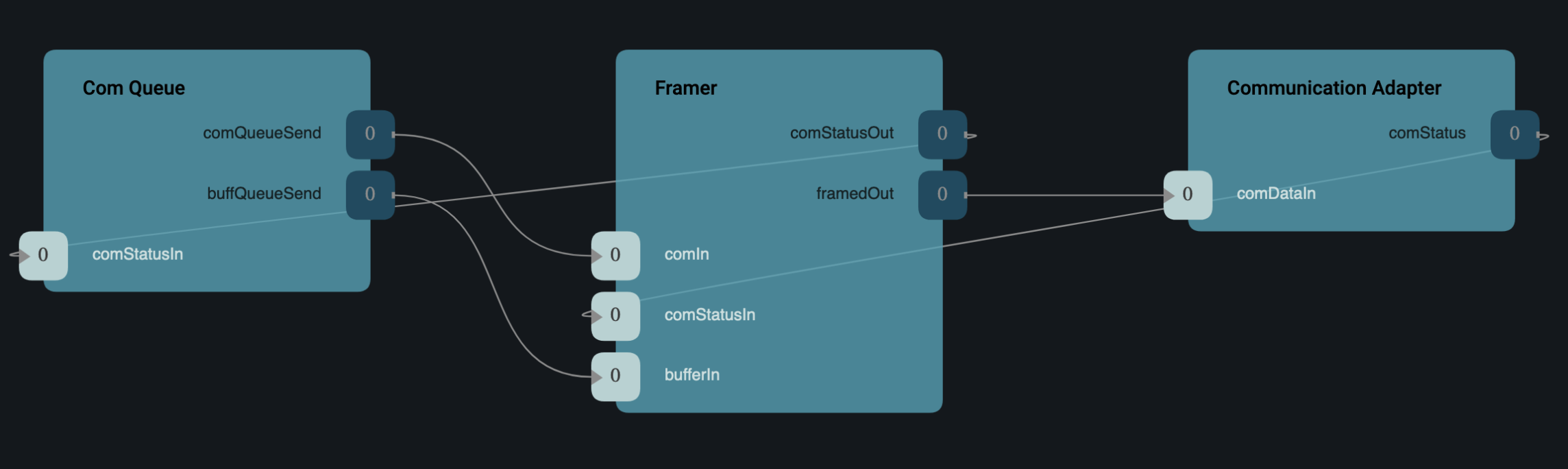
The communication adapter interface protocol is designed to work alongside the framer status protocol and the com queue protocol to ensure that data messages do not overload a communication interface. These protocols are discussed below.
Usage
Components implementing the Communication Adapter Interface should include the following in the FPP model:
This can be seen in Svc.ComStub.
Ports
The Svc.ComDataWithContext port type is used to transmit comms data between components of the F´ system. This port type is composed of a Fw::Buffer object and a ComCfg::FrameContext object. The Fw::Buffer object is used to transmit the data, while the ComCfg::FrameContext object is used to provide context for the data being transmitted, such as header information once the header has been consumed. The context's saIndex field carries the SDLS security association index (set by SDLS deframers and read by SDLS framers); the default ComCfg.SaIndexUnset (0xFFFF) is reserved to mean "unset". The context's firstHeaderPointer field carries the CCSDS TM First Header Pointer (set by Svc.ComAggregator on every aggregate — the offset of the first packet header, or 0x7FF for a continuation-only aggregate when packet spanning is enabled — and read by Svc.Ccsds.TmFramer); the default of 0 indicates a packet header at the start of the frame data field.
The communication adapter interface is composed of five ports. These ports are used to transmit outgoing data through some communication hardware and receive incoming data from that same hardware. These ports share types with the byte stream driver model for backwards compatibility.
| Kind | Suggested Name | Port Type | Description |
|---|---|---|---|
input |
dataIn |
Svc.ComDataWithContext |
Port receiving data for outgoing transmission (to be sent on the wire) |
output |
dataOut |
Svc.ComDataWithContext |
Port producing data from incoming transmissions (received on the wire) |
output |
dataReturnOut |
Svc.ComDataWithContext |
Port for sending back ownership of the Fw::Buffer received on the dataIn port |
input |
dataReturnIn |
Svc.ComDataWithContext |
Port for receiving back ownership of the Fw::Buffer sent on the dataOut port |
output |
comStatusOut |
Fw.SuccessCondition |
Port indicating status of outgoing transmission. See protocol. |
Note
About buffer management: after receiving a buffer on the dataIn port, the communication component must return ownership of said buffer through the dataReturnOut port. The common scenario is to connect dataIn and dataReturnOut to the same component, so that the sender can handle deallocation. This is done with a callback so that dataIn can be an asynchronous port if needed.
Similarly, the buffer sent out on dataOut is expected to be returned through the dataReturnIn port.
dataIn Description
This port receives data from an F´ application in the form of an argument of Fw::Buffer type and a ComCfg::FrameContext context. This data is intended to be sent out the communications interface managed by this component (often referred to as the wire). From the perspective of the application this is the outgoing data port.
dataOut Description
This port produces data to the F´ application once it is received on the wire. From the perspective of the application this is the incoming data port.
dataReturnOut Description
This port is used to send a callback returning ownership of the Fw::Buffer object that was received on the dataIn port. Ownership is typically returned to the sender. A callback is used so that dataIn may be an asynchronous port if needed.
dataReturnIn Description
This port is used to receive a callback returning ownership of the Fw::Buffer object that was sent on the dataOut port. Ownership is typically returned from the receiver of dataOut. A callback is used so that dataOut may be an asynchronous call if needed.
comStatusOut Description
This port carries a status of Fw::Success::SUCCESS or Fw::Success::FAILURE typically in response to a call to the dataIn port described above.
Note
It is critical to obey the protocol as described in the protocol section below.
Caution
Calls to comStatusOut must happen after calls to dataReturnOut returning the data the com status applies to.
Communication Queue Protocol
Svc::ComQueue queues messages until the communication adapter is ready to receive these messages. For each Fw::Success::SUCCESS message received, Svc::ComQueue will emit exactly one message. Svc::ComQueue will not emit messages at any other time. Fw::Success::FAILURE pauses the queue; data flow resumes only when a subsequent Fw::Success::SUCCESS is received.
The following rules govern the comStatusIn port of Svc::ComQueue:
- An initial
Fw::Success::SUCCESSmessage must be sent toSvc::ComQueueto initiate data flow (typically on start-up or driver connection) - Exactly one
Fw::Success::SUCCESSmust eventually be received in response to each emitted message for data to continue to flow Fw::Success::FAILUREpauses the queue — no messages will be emitted until a subsequentFw::Success::SUCCESSis received- After a
Fw::Success::FAILURE, aFw::Success::SUCCESSmust be sent to resume data flow (this SUCCESS does not correspond to any particular message — it indicates that the communication path has been restored)
Important
Fw::Success::SUCCESS is valid in three contexts: (1) at start-up to initiate data flow, (2) in response to a successfully transmitted message, and (3) after a previous Fw::Success::FAILURE to indicate recovery. No other uses of Fw::Success::SUCCESS are permitted.
These implications are discussed in more depth in the appropriate protocol sections.
Framer Status Protocol
Framing typically happens between Svc::ComQueue and a communications adapter. The action taken by this protocol is dependent on the number of framed messages (frames) sent to the communication adapter in response to each message received from Svc::ComQueue.
The Svc::FprimeFramer implements the Framer status protocol by emitting a frame for each message received from Svc::ComQueue. Therefore, the Svc::FprimeFramer receives a status from the communication adapter on each sent frame and forwards it back to Svc::ComQueue. This allows the data flow to continue, or pause if the communication adapter is unable to receive more data.
Framer implementations may choose to implement a different behavior. For example, a framer may choose to accept multiple messages from Svc::ComQueue and concatenate them in a single frame. In this case, the framer implementation must manage the flow of statuses accordingly. This is summarized in the table below.
| Produced Frames | Action | Rationale |
|---|---|---|
| 0 | Send one Fw::Success::SUCCESS status |
Data must continue to flow to produce a frame |
| 1 | Pass through received status from ComQueue | Frame produced and communication adapter produces status |
Important
All framer implementations must pass through the initiation message from the communication adapter to start data flow.
Communication Adapter Protocol
The communication adapter must obey a specific protocol to indicate to F´ application components the status of outgoing
transmissions. This is done with the comStatusOut port. A communication status is one of two possibilities:
| Status | Description |
|---|---|
| Fw::Success::SUCCESS | Communication adapter transmission succeeded and is ready for more data. |
| Fw::Success::FAILURE | Last transmission failed; communication adapter is unable to receive more data. |
A Communication Adapter shall emit comStatusOut signals according to the following rules:
-
On start-up / connection: The adapter shall emit exactly one
Fw::Success::SUCCESSto initiate data flow. This typically occurs when the underlying driver signals readiness (e.g. viadrvConnected). This initial SUCCESS is not in response to any data — it tellsSvc::ComQueuethat the adapter is ready to accept its first message. -
In response to data received on
dataIn: The adapter shall emit exactly one status (Fw::Success::SUCCESSorFw::Success::FAILURE) for each call received ondataIn. Fw::Success::SUCCESSindicates the transmission succeeded and the adapter is ready for the next message.-
Fw::Success::FAILUREindicates the transmission failed and the adapter is temporarily unable to receive more data. -
After a previous
Fw::Success::FAILURE: The adapter shall emit exactly oneFw::Success::SUCCESSonce communication has been restored. This recovery SUCCESS is not in response to any data — it tellsSvc::ComQueueto resume sending. The adapter is responsible for any retransmission of the failed data before emitting this recovery signal.
Important
Fw::Success::SUCCESS is valid in exactly three contexts: (1) at start-up to initiate data flow, (2) in response to a successful transmission of data received on dataIn, and (3) after a previous Fw::Success::FAILURE to indicate recovery. Each received message on dataIn must eventually result in a Fw::Success::SUCCESS — either directly on success, or via the failure-then-recovery sequence.
Since the communication status reflects the status of a specific data transmission, it must be sent after the return (deallocation) of that data via the dataReturnOut port.
Caution
Calls to comStatusOut must happen after calls to dataReturnOut returning the data the status applies to.
Note
It is imperative that Communication Adapters implement the comStatusOut protocol correctly.