Svc::DpWriter (Active Component)
1. Introduction
Svc::DpWriter is an active component for writing data products to disk.
It does the following:
-
Receive buffers containing filled data product containers. The buffers typically come from one or more components that produce data products. They typically pass through an instance of
Svc::DpManager, and possibly through an instance ofSvc::BufferAccumulator, before reachingDpWriter. -
For each buffer B received in step 1:
-
Perform any requested processing, such as data compression, on B.
-
Write B to disk.
-
If a notification port is connected, then send out a notification that the write occurred. An instance of
Svc::DpCatalogcan receive this notification and use it to update the data product catalog.
2. Requirements
| Requirement | Description | Rationale | Verification Method |
|---|---|---|---|
| SVC-DPWRITER-001 | Svc::DpWriter shall provide an array of ports for receiving Fw::Buffer objects pointing to filled data product containers. |
The purpose of DpWriter is to write the data products to disk. The array permits the fusion of multiple logical writer components with separate routing paths into a single component. This fusion increases resource efficiency (it requires fewer component instances and threads), but it restricts concurrency by forcing sequential execution of all routing paths on the same thread. The component allows developers to manage this tradeoff. |
Unit Test |
| SVC-DPWRITER-002 | Svc::DpWriter shall provide an array of ports for sending Fw::Buffer objects for processing. |
This requirement supports downstream processing of the data in the buffer. | Unit Test |
| SVC-DPWRITER-003 | On receiving a data product container C, Svc::DpWriter shall use the processing type field of the header of C to select zero or more processing ports to invoke, in port order. |
The processing type field is a bit mask. A one in bit 2^n in the bit mask selects port index n. |
Unit Test |
| SVC-DPWRITER-004 | On receiving an Fw::Buffer B, and after performing any requested processing on B, Svc::DpWriter shall write B to disk. |
The purpose of DpWriter is to write data products to the disk. |
Unit Test |
| SVC-DPWRITER-005 | Svc::DpWriter shall provide an array of ports for notifying other components that data products have been written. A notification shall use the same routing port index as the corresponding input buffer. |
The notification output allows Svc::DpCatalog or a similar component to update a data product catalog in real time. It is possible to notify a single instance of Svc::DpCatalog of all outputs, by connecting all the output ports of Svc::DpWriter to that component. It is also possible to notify different components via the different output ports. The array preserves symmetry across the port behaviors of this component (input, buffer return, and notification). |
Unit Test |
| SVC-DPWRITER-006 | Svc::DpWriter shall provide telemetry that reports the number of buffers received, the number of data products written, the number of bytes written, the number of failed writes, and the number of errors. |
This requirement establishes the telemetry interface for the component. | Unit test |
| SVC-DPWRITER-007 | On receiving an Fw::Buffer B, and after performing any requested processing on B, Svc::DpWriter shall re-parse the container header and shrink the size of the product. |
Allows processing interfaces to compress data products and communicate that compressed state back to Svc::DpWriter. |
Unit Test |
| SVC-DPWRITER-008 | Svc::DpWriter shall return each valid received buffer on the deallocBufferSendOut port whose index matches the bufferSendIn port that received it. |
Matching send and return paths allows a DpWriter instance to route buffers back toward the correct allocator. |
Unit Test |
3. Design
3.1. Component Diagram
The diagram below shows the DpWriter component.

3.2. Ports
DpWriter has the following ports:
| Kind | Name | Port Type | Usage |
|---|---|---|---|
async input |
schedIn |
Svc.Sched |
Schedule in port |
async input |
bufferSendIn |
[DpWriterNumPorts] Fw.BufferSend |
Ports for receiving data products to write to disk |
output |
procBufferSendOut |
[DpWriterNumProcPorts] Fw.BufferSend |
Port for processing data products |
output |
dpWrittenOut |
[DpWriterNumPorts] DpWritten |
Ports for sending DpWritten notifications |
output |
deallocBufferSendOut |
[DpWriterNumPorts] Fw.BufferSend |
Ports for returning data product buffers |
time get |
timeGetOut |
Fw.Time |
Time get port |
telemetry |
tlmOut |
Fw.Tlm |
Telemetry port |
event |
eventOut |
Fw.Log |
Event port |
text event |
textEventOut |
Fw.LogText |
Text event port |
The bufferSendIn, dpWrittenOut, and deallocBufferSendOut arrays form matching routing paths. A buffer received at index N is notified and returned through index N. Topologies must connect deallocBufferSendOut[N] for every connected bufferSendIn[N]; the buffer return is unconditional and invoking an unconnected return port asserts. dpWrittenOut[N] may be left unconnected.
3.3. State
DpWriter maintains the following state:
| Member | Type | Description |
|---|---|---|
m_numBuffersReceived |
U32 |
The number of buffers received |
m_numBytesWritten |
U64 |
The number of bytes written |
m_numSuccessfulWrites |
U32 |
The number of successful writes |
m_numFailedWrites |
U32 |
The number of failed writes |
m_numErrors |
U32 |
The number of errors |
The component also retains its configured file-name prefix in m_dpFileNamePrefix.
3.4. Compile-Time Setup
-
The configuration constant
DpWriterNumPortsspecifies the number of matched input, notification, and buffer-return routing paths. Its default value is five, matching the defaultDpManagerNumPortsconfiguration. Projects can override this value to fit their topology. All routing paths share one message queue withschedInand the asynchronousCLEAR_EVENT_THROTTLEcommand. Size the queue for the sum of the maximum queued buffers across all connected paths, plus the maximum pending scheduler ticks and commands. If at most one tick and one command can be pending, reserve at least two additional slots; deployments permitting larger bursts must reserve more. A full queue asserts. -
The configuration constant
DpWriterNumProcPortsspecifies the number of ports for connecting components that perform processing. -
The configuration
DP_FILENAME_FORMATspecifies the file name format.
3.5. Runtime Setup
You can call the configure function to supply the DP file name
prefix. This is the prefix used when constructing names of files to write.
For more information about the file name format, see the File
Format section.
If you do not call the configure function, then the default
DP file name prefix is the empty string.
3.6. Port Handlers
3.6.1. schedIn
This handler sends out the state variables as telemetry.
3.6.2. bufferSendIn
This handler receives a mutable reference to a buffer B on routing port N.
It does the following:
-
Check that
Bis valid. If not, emit a warning event. -
If the previous step succeeded, then check that the size of
Bis large enough to hold a data product container packet. If not, emit a warning event. -
If the previous steps succeeded, then check that the packet header of
Bcan be successfully deserialized. If not, emit a warning event. -
If the previous steps succeeded, then check that the header hash of
Bis valid. If not, emit a warning event. -
If the previous steps succeeded, then check that the data size recorded in the packet header fits within the buffer. If not, emit a warning event.
-
If the previous steps succeeded, then
-
Read the
ProcTypefield out of the container header stored in the memory pointed to byB. Let the resulting bit mask beM. -
Visit the port numbers of
procBufferSendOutin order. For each port numberP, ifPis set inM, then invokeprocBufferSendOutat port numberP, passing inB. This step updates the memory pointed to byBin place. -
Re-parse the container header pointed to by
B. If necessary, shrink the size of theBbuffer to be consistent with the data size in the updated container header. -
Write
Bto a file, using the format described in the File Format section. For the time stamp, use the time provided bytimeGetOut. -
If the file write succeeded and
dpWrittenOut[N]is connected, then send the file name, priority, and file size out ondpWrittenOut[N]. -
If
Bis valid, then sendBondeallocBufferSendOut[N].
4. File Format
4.1. Data Format
Each file stores a serialized data product record, with the format described in the data products documentation.
4.2. File Name
The name of each file is formatted with the configurable format string
DP_FILENAME_FORMAT.
The format string must contain format specifications for the following arguments,
in order.
| Format Specifier | Type |
|---|---|
| The DP file name prefix | %s |
| Container ID | %PRI_FwDpIdType |
| Time seconds | %PRI_u32 |
| Time microseconds | %PRI_u32 |
The exact meaning of the DP file name prefix depends on the format string. Typically it is a directory path prefix.
5. Ground Interface
5.1. Commands
| Kind | Name | Description |
|---|---|---|
async |
CLEAR_EVENT_THROTTLE |
Clear event throttling |
5.2. Telemetry
| Name | Type | Description |
|---|---|---|
NumBuffersReceived |
U32 |
The number of buffers received |
NumBytesWritten |
U64 |
The number of bytes written |
NumSuccessfulWrites |
U32 |
The number of successful writes |
NumFailedWrites |
U32 |
The number of failed writes |
NumErrors |
U32 |
The number of errors |
5.3. Events
| Name | Severity | Description |
|---|---|---|
InvalidBuffer |
warning high |
Incoming buffer is invalid |
BufferTooSmallForPacket |
warning high |
Incoming buffer is too small to hold a data product packet |
InvalidHeaderHash |
warning high |
Incoming buffer has an invalid header hash |
InvalidHeader |
warning high |
An error occurred while deserializing the packet header |
BufferTooSmallForData |
warning high |
Buffer is too small for the data size specified in the header |
FileNameFormatError |
warning high |
An error occurred when formatting a file name |
FileOpenError |
warning high |
An error occurred when opening a file |
FileWriteError |
warning high |
An error occurred when writing to a file |
FileWritten |
activity low |
A data product file was written |
6. Example Uses
6.1. Topology Diagrams
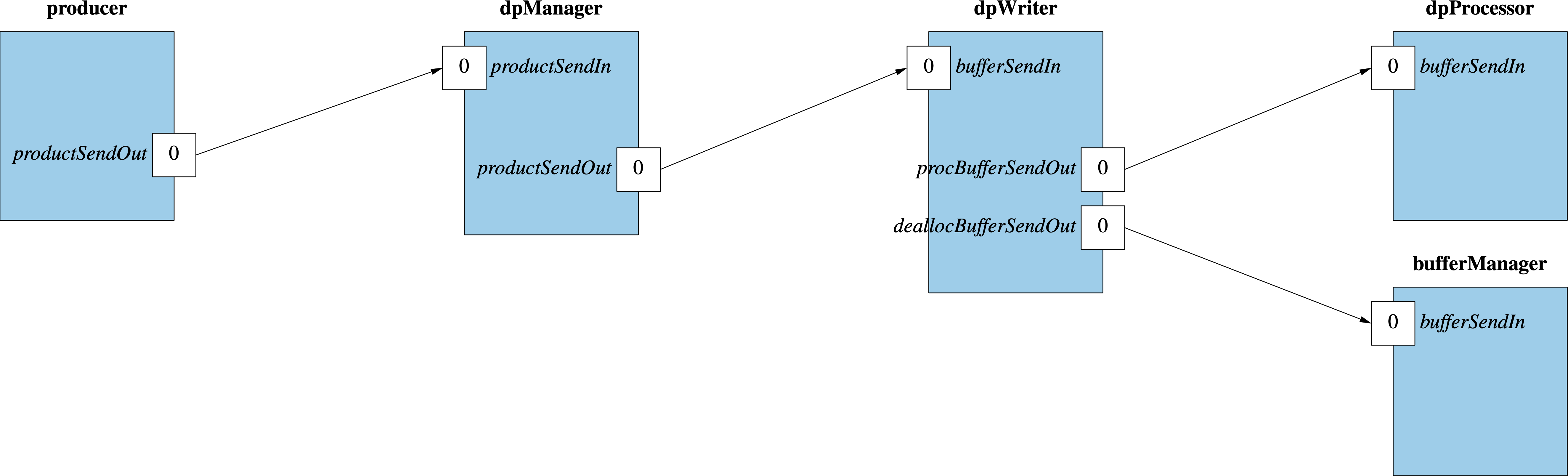
The following topology diagram shows how to connect Svc::DpWriter
to a DpManager component and a processor component.
The diagrams use the following instances:
-
dpManager: An instance ofSvc::DpManager. -
dpProcessor: A component that processes data product containers. -
dpWriter: An instance ofSvc::DpWriter. -
producer: A component that produces data products.
6.2. Sequence Diagrams
The following diagram shows what happens when a buffer is sent to DpWriter,
is processed, and is written to disk.
sequenceDiagram
    activate producer
    activate dpManager
    activate dpWriter
    producer-)dpManager: Send buffer
    dpManager-)dpWriter: Send buffer [bufferSendIn]
    dpWriter->>dpProcessor: Process buffer B [procBufferSendOut]
    dpProcessor-->>dpWriter: Return
    dpWriter->>dpWriter: Write B to disk
    dpWriter->>bufferManager: Deallocate B [deallocBufferSendOut]
    bufferManager-->>dpWriter: Return
    deactivate dpWriter
    deactivate dpManager
    deactivate producer