Svc::TlmChan Component
1. Introduction
The Svc::TlmChan Component is used to store telemetry values written by other components. The values are stored in serialized form.
The data is stored as a set of telemetry channels in a table.
The data can be individually read back or periodically pushed to another component for transporting out of the system.
Svc::TlmChan is an implementation of the Svc::TlmStore component in the Svc/Tlm directory.
2. Requirements
The requirements for Svc::TlmChan are as follows:
| Requirement | Description | Verification Method |
|---|---|---|
| TLC-001 | The Svc::TlmChan component shall provide an interface to submit telemetry |
Unit Test |
| TLC-002 | The Svc::TlmChan component shall provide an interface to read telemetry |
Unit Test |
| TLC-003 | The Svc::TlmChan component shall provide an interface to run periodically to write telemetry |
Unit Test |
| TLC-004 | The Svc::TlmChan component shall write changed telemetry channels when invoked by the run port |
Unit Test |
| TLC-005 | The Svc::TlmChan component shall limit the number of telemetry entries processed per Run invocation to TLMCHAN_MAX_ENTRIES_PER_RUN |
Unit Test |
| TLC-006 | The Svc::TlmChan component shall emit a WARNING_HI event when the per-run processing cap is reached |
Unit Test |
3. Design
3.1 Context
3.1.1 Component Diagram
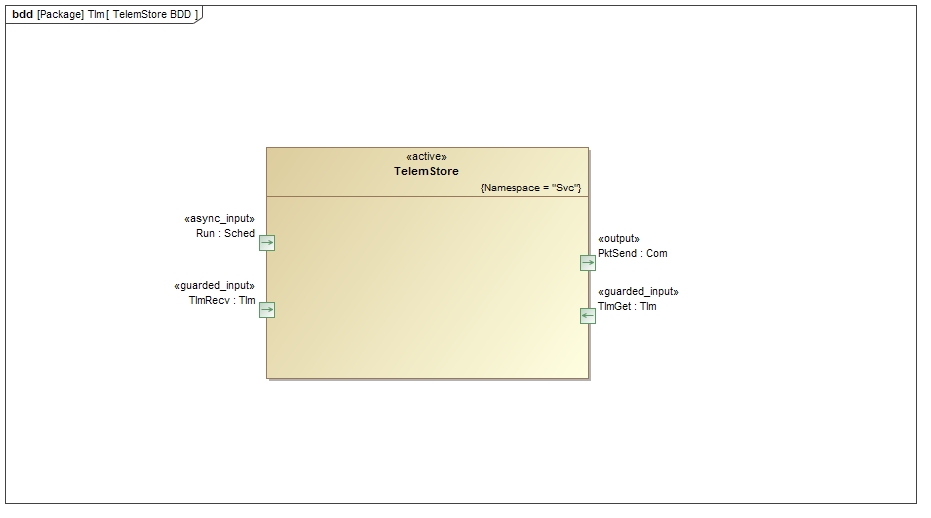
The Svc::TlmChan component has the following component diagram:
3.1.2 Ports
The Svc::TlmChan component uses the following port types:
| Port Data Type | Name | Direction | Kind | Usage |
|---|---|---|---|---|
Svc::Sched |
Run | Input | Asynchronous | Execute a cycle to write changed telemetry channels |
Fw::Tlm |
TlmRecv | Input | Guarded Input | Update a telemetry channel |
Fw::TlmGet |
TlmGet | Input | Guarded Input | Read a telemetry channel |
Fw::Com |
PktSend | Output | n/a | Write a set of packets with updated telemetry |
Svc::Ping |
pingIn | Input | Asynchronous | Receive a ping to verify liveness |
Svc::Ping |
pingOut | Output | n/a | Return ping response |
Fw::Time |
timeCaller | Output | n/a | Retrieve current time for hash seed initialization |
Fw::Log |
eventOut | Output | n/a | Emit structured events (e.g. processing cap warning) |
Fw::LogText |
eventOutText | Output | n/a | Emit text-form events for ground display |
3.2 Functional Description
The Svc::TlmChan component has an input port TlmRecv that receives channel updates from other components in the system. These calls from the other components are made by the component implementation classes, but the generated code in the base classes takes the type specific channel value and serializes it, then makes the call to the output port. The Svc::TlmChan component can then store the channel value as generic data. The channel values are stored in an internal double-buffered table, and a flag is set when a new value is written to the channel entry.
When a request is made for a nonexistent channel, the call will return with an empty buffer in the Fw::TlmBuffer value argument. This is to cover the case where a channel is defined in the system, but has not been written yet. If the channel has not ever been defined, there is no way to programmatically determine that from the TlmGet port call.
The implementation uses a hashing function that is tuned in the configuration file TlmChanImplCfg.hpp. See section 3.5 for description.
3.2.1 Run Handler Processing Cap
To bound the worst-case execution time of the Run handler and protect the rate group from telemetry bursts (caused by hardware anomalies, runaway components, software faults, or cyber-attacks), a per-invocation processing cap is enforced. The cap is configured via TLMCHAN_MAX_ENTRIES_PER_RUN in TlmChanImplCfg.hpp.
During each Run invocation:
- Up to
TLMCHAN_MAX_ENTRIES_PER_RUNupdated entries are serialized into downlink packets and sent viaPktSend. - Any updated entries beyond this limit are deferred (skipped) for the current cycle. Deferred entries are not re-queued; they are dropped when the active buffer is swapped at the start of the next
Runinvocation. - If any entries are deferred, a
WARNING_HIeventTlmChanEpochProcessingCapReachedis emitted viaeventOutreporting the number of dropped entries and the cumulative count of invocations where the cap was reached.
The default value of TLMCHAN_MAX_ENTRIES_PER_RUN is TLMCHAN_HASH_BUCKETS, which makes the cap a no-op and preserves identical behavior to prior versions. Deployments that need to bound Run handler execution time can lower this value.
3.3 Scenarios
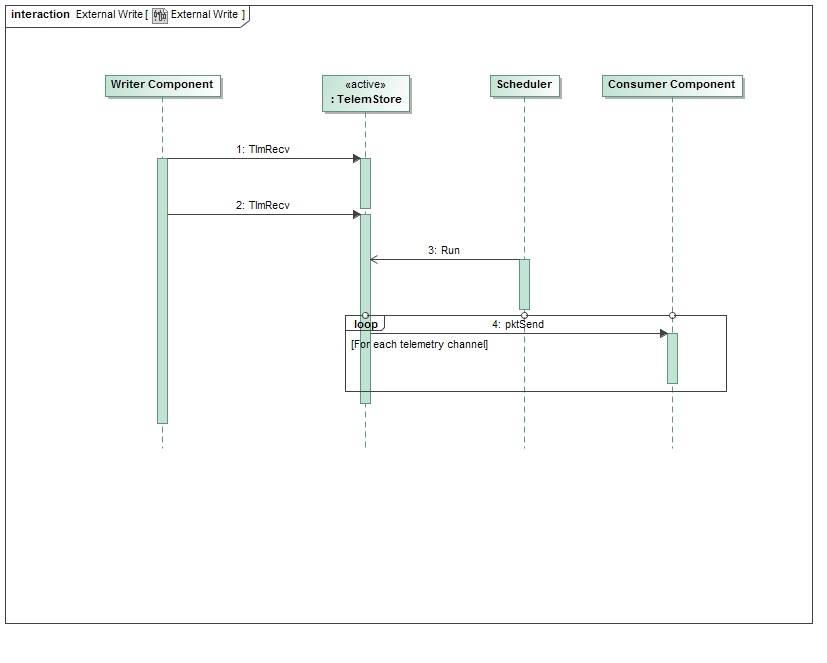
3.3.1 External User Option
This diagram shows the scenario where telemetry packets are generated for an external user:
3.3.2 Telemetry Database Option
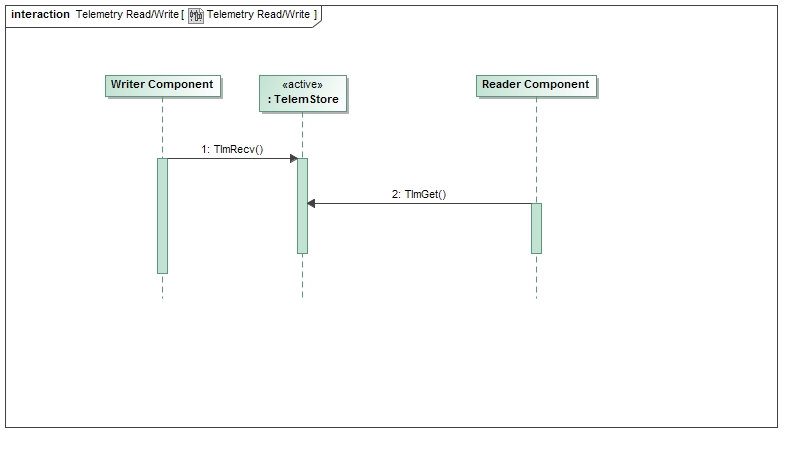
This diagram shows the scenario where telemetry packets are stored and retrieved as a database:
3.4 State
Svc::TlmChan has no state machines.
3.5 Algorithms
3.5.1 Hash Function
In order to speed up lookups for storing and reading telemetry channels, a seeded hash function is used to select a location in an array of hash table slots. Configuration values in TlmChanImplCfg.hpp define the number of hash buckets and slots. The number of buckets must be at least as large as the number of telemetry channels defined in the system. The number of channels in the system can be determined by invoking make comp_report_gen from the deployment directory. TLMCHAN_NUM_TLM_HASH_SLOTS and TLMCHAN_HASH_MOD_VALUE can be varied to balance the amount of memory for slots versus the distribution of buckets to slots. See TlmChanImplCfg.hpp for tuning guidance.
The hash algorithm is selected based on the deployed size of FwChanIdType:
FwChanIdType size |
Algorithm | Constants |
|---|---|---|
| ≥ 4 bytes (32-bit) | Murmur3 32-bit finalizer | MURMUR3_C1 = 0x85EBCA6B, MURMUR3_C2 = 0xC2B2AE35 |
| 2 bytes (16-bit) | Wang 16-bit hash | WANG16_C1 = 0x2993, WANG16_C2 = 0xE877 |
| 1 byte (8-bit) | XOR + modulo reduction | n/a |
All three paths XOR the channel ID with a per-boot seed before hashing, then reduce the result modulo TLMCHAN_NUM_TLM_HASH_SLOTS.
3.5.2 Hash Seed
The hash seed is computed once at construction time using Os::RawTime (OSAL-backed, no STL dependency) combined with stack-address entropy. The seed is stored in m_hashSeed and remains constant for the lifetime of the component. A non-zero seed is guaranteed; if the combined value is zero a known non-zero fallback constant is substituted.
Where the platform provides genuine boot-time entropy (a high-resolution clock that advances between boots and/or address-space randomization), the seed varies per boot, which raises the cost for an adversary attempting to craft channel IDs that collide to the same hash slot. On bare-metal targets without these properties (fixed boot-time clock value, deterministic memory layout) the seed may be effectively constant across boots; such deployments should supply a platform entropy source through the OSAL before relying on per-boot seed diversity as a security property.
3.6 Events
| Event | Severity | Arguments | Description |
|---|---|---|---|
TlmChanEpochProcessingCapReached |
WARNING_HI | numDeferred: U32, numTimesDeferredCountReached: U32 |
Emitted when Run_handler reaches TLMCHAN_MAX_ENTRIES_PER_RUN before processing all updated entries. numDeferred is the count of entries dropped this cycle; numTimesDeferredCountReached is the cumulative count of invocations where the cap was reached. |
4. Dictionaries
TBD
5. Module Checklists
| Checklist |
|---|
| Design |
| Code |
| Unit Test |
6. Unit Testing
To see unit test coverage run fprime-util check --coverage
7. Change Log
| Date | Description |
|---|---|
| 6/23/2015 | Design review edits |
| 7/22/2015 | Design review actions |
| 9/28/2015 | Unit Test Review additions |
| 2026 | Added seeded Murmur3/Wang hash algorithm (replaces linear modulo); added TLMCHAN_MAX_ENTRIES_PER_RUN processing cap; added TlmChanEpochProcessingCapReached WARNING_HI event; added timeCaller, eventOut, eventOutText, pingIn, pingOut ports |