Svc::WasmSequencer
A sequence engine based around a WebAssembly (Wasm) interpreter.
Introduction
WasmSequencer is a component that implements the F´ sequencing paradigm to dispatch commands, events, read telemetry parameters and more. It is based around the WebAssembly standard.
The component integrates a WebAssembly interpreter capable of loading validating and executing WebAssembly modules. Two state machines to manage the life-cycle and execution of the interpreter.
WebAssembly Overview
This section describes some important WebAssembly concepts and how WasmSequencer interacts with them. For complete documentation, see the WebAssembly 1.0 Specification.
Types
There are four distict types who share the same name (and meaning) with their F´ equivalents: i32, i64, f32, f64.
Notice that these are a subset of the typical representable scalars. These types are used to describe global variables, function parameters, return values, local variables etc. Wasm can still operate on memory using aribtrary bit-width scalars. This is similar to a standard computer instruction set with 32 and 64-bit floating and integer registers.
Functions
A function in Wasm consists of the following properties:
- A set of local variables defined as a set of (n, type) pairs where
nis the number of locals andtypethe set of local's type. - A signature that specifies the function's parameters and returns as lists of types.
- For example:
[i32, i64] -> [f32]describes a function that accepts ani32andi64parameter and returns anf32. - Wasm 1.0 only allows zero or one value in the return.
Functions can be invoked and executed by the engine. The combination of the parameters and locals creates a frame.
Note
Functions do not have names. They have a signature, local variables and a body (instruction sequence). Names are given only to exported definitions (see section below).
Modules
A module is a basic loadable Wasm unit. A .wasm file represents a single module.
Modules are represented as lists of certain definitions which you can read about in the spec.
This document focuses on a subset of these members.
- Functions: A list of functions referenced by their index.
- Start: An optional function index. This function must be signature
[] -> []and will be run when the module is loaded before the entrypoint is run. - Globals: A value that can be written/read externally and by the guest program. Optionally mutable.
- Memory: A region of RAM that can be accessed by the guest program.
- The size is specified in the Wasm module. A
minand optionalmaxsize is specified up-front. - The memory is instantiated at the
minsize.memory.growis supported subject to the restrictions in Guest Memory. - Only a single memory per module is supported in Wasm 1.0.
-
Imports: Members of other modules that are added to this module (linking). Imports specify both a module name (names another previously loaded module) and a definition's name (name of export in external module). The following imports are supported in WebAssembly:
-
Functions. Includes an expected signature.
- Globals. Includes an expected type/mutability.
-
More. These are typically not utilized and are not described in this document.
-
Exports: Definitions in this module that are made accessible to other modules in the store. Exports have the following three properties:
- Kind: Function, global, etc.
- Name: A string naming the definition. Another module can link to this export by naming it as an import.
- Index: Index in the corresponding list in this module.
Tip
Exports can name/re-export a definition listed as an import.
Store
Holds the set of loaded modules. As a module is loaded, it is linked against the store and the imports are resolved against exports of previously loaded modules.
Tip
The name of a module is not defined inside the module itself. It is provided when loading the module. A module can be named by the LOAD command in WasmSequencer. See linking.
Engine
The engine encompasses the store and the interpreter. The engine can load and validate modules, invoke functions and execute Wasm instructions in the interpreter. The interpreter holds the state of the Wasm execution. The interpreter state is initially seeded by a function invocation. The interpreter state consists of:
pc: The program counter.sp: The stack pointer.fp: The frame pointer.- More.
Guest
The Wasm guest refers to the execution context inside of the Wasm runtime. When you load a .wasm module and invoke it's entrypoint, the program executes as a guest. The engine isolates the guest from the rest of the flight-software.
Host
The Wasm host refers to the context that surrounds the Wasm engine and provides access outside of the guest. WasmSequencer is the host. The host can provide special modules to the store called host modules. Host modules can bind native C++ functions (and other definitions) as Wasm exports. Guest modules can import host functions to interact with curated FSW behaviors. See host functions for a full description of the built-in fprime_v1 host module.
Build Dependencies
The spacewasm engine is written in Rust and compiled into a static library at build time, so building this component requires a Rust toolchain (cargo and rustc) on the PATH. This is the framework's only Rust dependency, so it is treated as optional: cmake/required.cmake detects cargo, and Svc/CMakeLists.txt skips Svc::WasmSequencer.
Requirements
| Name | Description | Rationale | Validation |
|---|---|---|---|
| WASM-SEQ-001 | The sequencer shall support loading and validating WebAssembly modules. | Sequences are distributed as WebAssembly binaries; a module must be decoded and validated before execution so a malformed or untrusted binary cannot corrupt the host. | Unit Test |
| WASM-SEQ-002 | The sequencer shall support loading multiple named modules so that the exports of one module may be referenced by another. | Larger sequences are composed from reusable library modules; naming lets inter-module imports and exports resolve within a single store. | Unit Test |
| WASM-SEQ-003 | The sequencer shall allocate its module store for a fixed, configured capacity and shall reset it on a failed load. | Flight software forbids heap fragmentation; a fixed-capacity store with a full reset on failure keeps allocation deterministic and returns to a known-good state. | Unit Test |
| WASM-SEQ-004 | The sequencer shall resolve sequence file paths relative to a configurable base directory. | Onboard sequence storage varies by deployment; a parameterized base directory avoids hard-coding filesystem layout into the flight software. | Unit Test |
| WASM-SEQ-005 | The sequencer shall support running sequences with arguments. | Passing arguments at dispatch time lets a single sequence binary be parameterized, so operators can reuse one module across scenarios instead of rebuilding per run. | Unit Test |
| WASM-SEQ-006 | The sequencer shall support invoking a previously loaded module's entry point on demand. | Decoupling load from invoke lets a module be validated and staged ahead of time, then executed without re-reading the file. | Unit Test |
| WASM-SEQ-007 | The sequencer shall support both blocking and non-blocking sequence execution. | Blocking lets a controlling sequence or operator wait for completion; non-blocking allows fire-and-forget dispatch. Both are needed depending on the caller's intent. | Unit Test |
| WASM-SEQ-008 | The sequencer shall bound the number of interpreter instructions executed per cycle. | Fuelling the interpreter keeps a long-running or malicious guest from starving the component thread and preserves responsiveness to pause and cancellation. | Unit Test |
| WASM-SEQ-009 | The sequencer shall support pausing a running sequence before the next directive and later resuming it. | Operators need to halt a sequence at a safe point for inspection or intervention and resume it without restarting from the beginning. | Unit Test |
| WASM-SEQ-010 | The sequencer shall support cancelling a loading, ready, or running sequence and returning to the idle state. | An operator must be able to abort a misbehaving or unneeded sequence at any point and clear the store to a known-good idle state. | Unit Test |
| WASM-SEQ-011 | The sequencer shall fail a sequence whose current blocking host function does not complete within a configurable timeout. | A command or serial reply that never arrives would block the sequencer indefinitely; a per-host-function timeout bounds the wait and fails the sequence safely. | Unit Test |
| WASM-SEQ-012 | The sequencer shall let a sequence read the current spacecraft time, telemetry channel values, and parameter values. | Time-aware and conditional sequences must branch on the host's authoritative time, live telemetry, and configured parameters rather than guest-local state. | Unit Test |
| WASM-SEQ-013 | The sequencer shall support dispatching commands. | Command dispatch is the primary mechanism by which a sequence actuates the spacecraft. | Unit Test |
| WASM-SEQ-014 | The sequencer shall let a sequence emit events at the non-reserved F´ severities. | Guest programs need operator-visible logging; restricting to WARNING_LO/HI, ACTIVITY_LO/HI and DIAGNOSTIC severities prevents untrusted code from triggering the FATAL handler or spoofing command events. |
Unit Test |
| WASM-SEQ-015 | The sequencer shall let a sequence sleep for a relative or absolute duration. | Sequences must pace their actions against wall-clock time (settling delays, timed maneuvers) without busy-waiting and consuming interpreter fuel. | Unit Test |
| WASM-SEQ-016 | The sequencer shall let a sequence support invoking a serial output port at a given index. | General communication with other components (or sequencers) is useful for synchronizing actions or communicating state. Projects can decide how and what capabilities are exposed to sequences. | Unit Test |
| WASM-SEQ-017 | The sequencer shall let a sequence read a message from a serial input port, either blocking until one arrives or returning immediately when none is queued. | The inverse of WASM-SEQ-016 is needed to support general communication between other components or sequences. Blocking and non-blocking receives are useful mechanisms to implement event driven and polling workloads. | Unit Test |
| WASM-SEQ-018 | The sequencer shall treat a sequence that terminates with a zero return value or a zero exit code as a success, and a non-zero return value, a non-zero exit code, or a panic as a failure. | Guests need a clean way to end execution; treating a zero return or exit(0) as success and any non-zero return value, non-zero exit code, or panic as a failure lets the host report the correct verdict to the awaiting command. | Unit Test |
| WASM-SEQ-019 | The sequencer shall validate all host-function arguments from the guest and never fault the host on invalid input, reporting an event and failing or trapping the sequence instead. | Untrusted guest code must never be able to crash the host. This covers oversized/undersized buffers, out-of-range or unconnected serial ports, invalid guest memory pointers, and reserved-severity event requests, all of which are rejected gracefully rather than asserting. | Unit Test |
| WASM-SEQ-020 | The sequencer shall report its current state, running sequence name, and most recent trap reason as telemetry. | Operators need continuous visibility into what the sequencer is doing and why a sequence stopped without pulling a full event log. | Unit Test |
| WASM-SEQ-021 | The sequencer shall count and report sequences succeeded, failed, and cancelled, and commands dispatched and failed. | Aggregate counters give operators a quick health indicator and let ground trend sequence and command reliability over a mission. | Unit Test |
| WASM-SEQ-022 | The sequencer shall let a running sequence grow its linear memory via memory.grow in strictly O(1) time complexity. Disallowed growth shall telemetry reason to operator. |
Guests that size working buffers at run time need memory.grow. Certain kinds of memory growth are O(1) (i.e. increment a counter) while others require O(n) data copy or move (these are not allowed). |
Unit Test |
| WASM-SEQ-023 | The sequencer shall let an operator read, and write (when mutable), a loaded module's exported globals addressed by module and global name. | Exposing module globals lets ground inspect and adjust sequence state (tuning constants, flags, thresholds) without reloading, and enables coordination through shared globals; type mismatches, immutable targets, and unknown module/global names are rejected without disturbing the store. | Unit Test |
| WASM-SEQ-024 | The sequencer shall reject a RUN, LOAD, or INVOKE request that arrives while it is already loading or running a sequence, responding BUSY without disturbing the in-progress sequence. |
The store and interpreter serve one sequence at a time. Reject overlapping requests with BUSY keeps execution deterministic and prevents a late or spurious request from corrupting an in-flight sequence. |
Unit Test |
Design
The design of this component is tightly coupled with the spacewasm WebAssembly engine, which performs module loading, validation, and instruction execution. Svc::WasmSequencer is an active component built around two FPP state machines: a controller that manages the module lifecycle (load, validate, initialize, run) and an interpreter that executes Wasm instructions and services the host functions a running sequence calls.
WebAssembly Engine
The engine, spacewasm, implements the official WebAssembly specification with the following features:
| Feature | Description |
|---|---|
| MVP | The Wasm MVP |
| Import/Export of mutable globals | Mutable globals (part of Wasm 1.0) |
| Custom Page Sizes | Linear memory page sizes < 64 KiB |
Unlike most production-grade Wasm engines, spacewasm is an interpreter — more precisely an IR interpreter: during load it translates Wasm byte-code into a resolved intermediate representation (IR) that it then decodes and executes in a loop. This is slower than a typical production just-in-time (JIT) compiler but provides determinism and safety guarantees as well as an extremely low memory footprint. This document does not cover the engine's internals, see the spacewasm repository for more details. A few of its design choices drive this component:
- Fuel: The interpreter loop runs at most a bounded number of IR instructions per call and then yields. A long-running or malicious guest cannot starve the component thread and
PAUSE/CANCELstay responsive. The bound is theINSTRUCTION_FUELparameter. This bounds per-cycle work, not total CPU; see Scheduling and CPU Budget. This parameter is clamped to be greater than zero so that each execution slice progresses the program counter. - Dynamic memory: spacewasm allocates its module data structures and compiled IR from a "global allocator" the embedder (WasmSequencer) provides. This component backs it with a per-instance pool of up to
SPACEWASM_MAX_PAGESfixed-size (SPACEWASM_PAGE_SIZE) pages, allocated up front inconfigure(), keeping peak memory deterministic and free of heap fragmentation. Guest linear memory is served from a second per-instance pool, also sized inconfigure(). See Heap Memory and Guest Memory. - Panics:
- Guest Panics: The Wasm guest can panic due to some invariant which fails the sequence execution and emits an event with the reason. The store is reset.
- Rust Panics: spacewasm is written in Rust and compiled with
panic = "abort". A panic is routed through aspacewasm_paniccallback that logs the location toOs::Consoleand thenFW_ASSERT(false). This path is reserved for an engine invariant violation: untrusted or malformed module bytes are contractually handled by gracefulSPACEWASM_ERR_*load-failure codes (surfaced as load-failure events), not panics. To keep the panic path from firing on arbitrary input, the upstream engine is fuzzed against valid and invalid Wasm modules using industry standard practices.
Specification divergences. spacewasm diverges from the spec in a few documented ways for determinism and adherence to flight-software standards:
- A failed module load invalidates the whole store, so the controller rebuilds the store from scratch on any load failure — the behavior required by WASM-SEQ-003.
- A module's optional
startfunction must resolve to a Wasm function (not a host function), so it can be driven through the same fuel-bounded run loop asmain. - This divergence is a minor detail/technicality and cannot surface to users as start function must be of signature
[] -> []and WasmSequencer does not expose any[] -> []host functions. memory.growhas some restrictions when using multiple modules. This is not imposed by SpaceWasm but by how WasmSequencer implements the memory allocator to adhere to FSW restrictions. See guest memory.
Modules, Names, and Linking
Each WasmSequencer holds a single store with a fixed-capacity table of up to Config::maxGuestModules guest modules (chosen per instance in configure()) plus the reserved host module. Each guest module is loaded under a name, which is how other modules (and later commands) refer to it. Loading is additive: each LOAD adds another module to the current store.
LOADloads a module under a caller-chosen name (which must not already be in use). Naming a module is what lets another module import its exports, and letsINVOKE,GLOBAL_GET, andGLOBAL_SETaddress it afterward. An empty name is the single-module shorthand.INVOKEruns themainentry point of an already-loaded module named by the caller (the empty name for a module loaded without one). See guest module entry point.RUNis the one-shot convenience for a self-contained module: it resets the store, loads the file under the empty name, and invokes itsmain. Because it resets the store first,RUNdiscards any modules previously staged withLOAD.
Linking. A guest module's Wasm imports are (module, field) pairs resolved at load time against what is already in the store: the reserved host module fprime_v1 (with functions listed in Host Functions) and any guest module already loaded under the referenced name. fprime_v1 is always available in the store (restored when the store is reset). Since resolution happens at load time, a library module must be loaded before the module that imports it. A multi-module sequence therefore stages its libraries first:
LOAD    mathlib.wasm  "math"    ; exports add, mul
LOAD    app.wasm      "app"     ; imports ("math", "add"), ...
INVOKE  "app"
A module's exported globals can be printed in an event using GLOBAL_GET and written to (if mutable) using GLOBAL_SET.
Guest Module Entry Points
LOAD only decodes, validates, and links a module into the store. It has no entry-point requirements. A module intended purely as a library (imported by another module, or only read/written via GLOBAL_GET/GLOBAL_SET) needs neither a main nor a start function.
RUN and INVOKE require an exported main function with the one following signatures:
[] -> []. In C:void main(). A sequence that returns from this function is counted as a successful run. Sequences with void returns can exit with failure by using theexitwith a non-zero code orpanichost functions.[] -> [i32]In C:int main(). Supportsexit/paniclike the void return version. Returning from this function has the same behavior asexit(zero for success, non-zero for failure).
start is optional and, if present, runs once before main. It is indended for host-side setup. It is the Wasm-spec start section (not a named export), so it can only be a guest-defined function, never a host import (checked at load time), and the spec fixes its signature to [] -> []. LOAD will execute the optional start function before completing.
State Machines
This component is driven by two state machines whose (flattened) leaf states are reported in telemetry.
Controller
The controller owns the module lifecycle: load, validate, and run. It starts in IDLE with no store. LOAD reads and validates a module into the store executes it's optional start function and settles in READY. RUN resets the store, does the same load, and then chains into the module's optional start function and its main entry point before returning to READY. In the READY state an operator may INVOKE a loaded module to execute the main function. A module's state (memory and globals) is maintained across successful INVOKEs. If any failure occurs, the controller will return to IDLE which clears the store and drops all state.
A few rules apply regardless of which state the controller is in:
- A failed load invalidates the whole store. spacewasm cannot partially roll back a load, so any load failure sends the controller back to
IDLE, whose entry rebuilds a fresh store. - Acknowledgement timing depends on
BLOCK. ANO_BLOCKcaller is acknowledged as soon as the sequence finishes loading (i.e. After the option start finishes running). aBLOCKcaller (and any pendingWAIT) is acknowledged only once themainrun finishes. A run only counts as a success if it exits with a zero return/exit code. - The controller rejects concurrent requests. A
RUN/LOAD/INVOKEthat arrives while the controller is already loading or running is rejected withBUSY. - Cancellation goes through the interpreter.
CANCELsignals the interpreter, which unwinds execution and reports back so the controller can count the sequence as cancelled. Cancellation will return the controller to idle which clears the store.
The diagram below traces a RUN's nominal life cycle end-to-end. LOAD follows the same load/start path but settles in READY without invoking main. INVOKE skips straight to the main-invoke step on a module already loaded by an earlier LOAD.
sequenceDiagram
    actor Caller
    participant Ctrl as Controller
    participant Engine as spacewasm
    participant Interp as Interpreter

    Caller->>Ctrl: RUN(file, args, block)
    Note over Ctrl: enter LOADING*
    Ctrl->>Engine: load module
    Engine-->>Ctrl: loadSucceeded

    opt module has a start function
        Ctrl->>Engine: invokeStart
        Ctrl->>Interp: runEngine
        Note over Ctrl: enter RUNNING_START*
        Interp-->>Ctrl: engineFinished
    end

    Ctrl->>Caller: OK (NO_BLOCK reply, sequence has started)

    Ctrl->>Engine: invokeMain
    Ctrl->>Interp: runEngine
    Note over Ctrl: enter RUNNING_MAIN
    Interp-->>Ctrl: engineFinished
    Ctrl->>Caller: OK (BLOCK caller + any pending WAIT)
    Note over Ctrl: enter READY
The full state machine including all the failure points is much more complex though captures the full scope of what the controller manages:
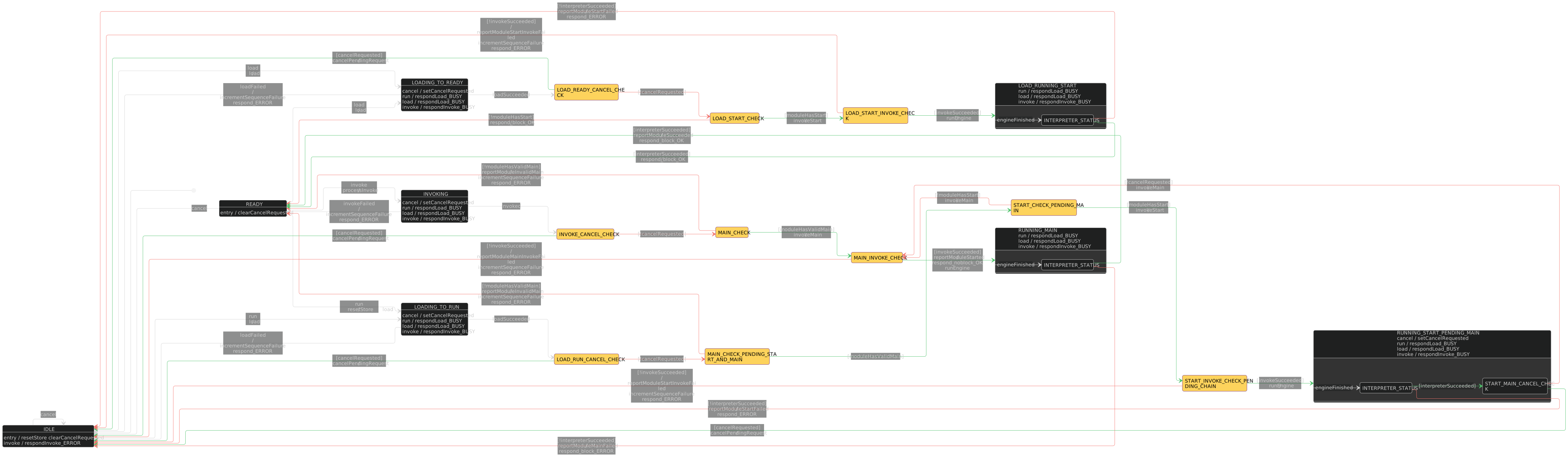
The controller manages the following failure points during a module's load, initialization and execution:
- A module fails to load/validate.
- A cancellation mid-load.
- A module with given name could not be found in the during an
INVOKE+. - A module's start function could not be invoked*.
- A module has an invalid
main(missing or invalid signature)+. - A module's
mainfunction could not be invoked*. - The start function exited with error (or trapped).
- The
mainfunction exited with error (or trapped).
Most failures will clear the store and return to IDLE.
* Function invocations can fail if the stack frame required to run the function overflows the interpreter's allocated stack.
+ Recoverable errors during INVOKE that will return to READY without clearing the store.
Interpreter
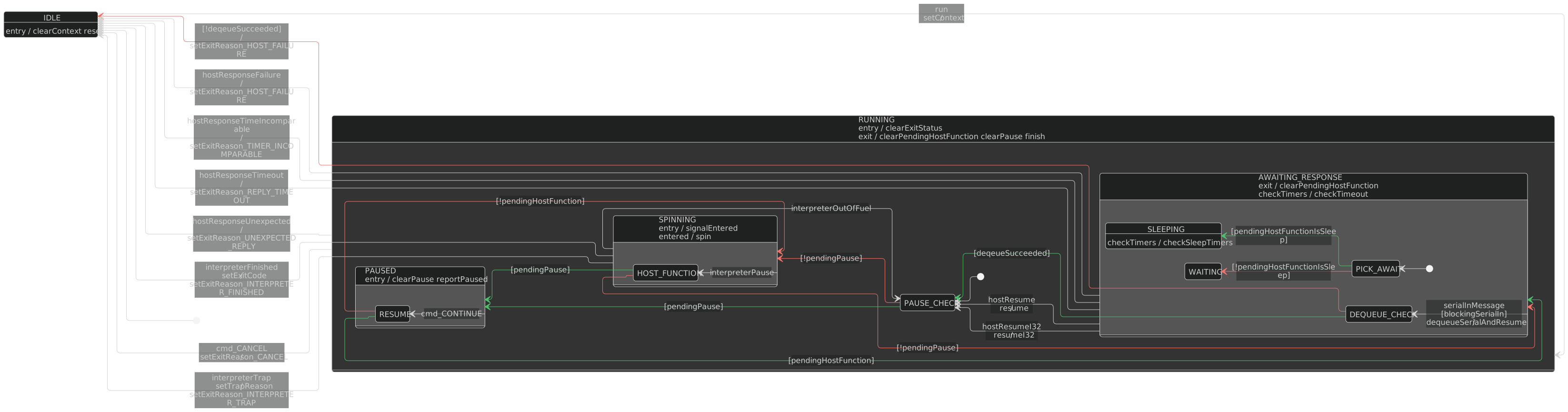
The interpreter executes the loaded program and services the host functions it calls, one fuel-bounded slice at a time.
- Slices are fuel-bounded. Each slice spins the interpreter loop until it finishes, traps, exhausts its
INSTRUCTION_FUEL, or a host function call pauses it. Running out of fuel simply starts another slice. A pendingPAUSEorCANCELis checked between slices, which is where either takes effect. - Every host function pauses the interpreter and is dispatched through
AWAITING_RESPONSE, but most resolve immediately within that same dispatch: reading time, telemetry, parameters, or invocation arguments, emitting an event, and sending serial output all signal their own resume before the guest ever waits. - Two host functions wait for an asynchronous reply. A dispatched command (
cmd) awaits its response oncmdResponseIn, and a blockingserial_recvawaits an inbound message onserialIn. Both are bounded by theHOST_FUNCTION_TIMEOUT_SECSparameter, checked on eachcheckTimerstick. - Sleeps run on their own timer.
rsleep/asleepwait on a guest-requested wake time rather than the host-function timeout, but are likewise checked eachcheckTimerstick. - Completion hands back execution to the controller. When the program ends, the interpreter records why — a normal finish (with its return code), a guest
exit/panic(with its code), or a byte-code trap (with its reason) — and signals the controller, which emits the matching completion event.
Guest Memory
This section describes the restrictions that WasmSequencer places on guest (linear) memory and it's growth (memory.grow instruction). First it is important to give a bit of context on how linear memory works in Wasm. Wasm defines every guest memory (linear memory) in units of pages. Wasm 1.0 defines each page as 64KiB however SpaceWasm implements the custom page sizes proposal which also allows pages to be 1 byte, effectively allowing arbitrarily sized linear memory allocations. Wasm memories are defined as a single minimum size and an optional maximum in page units (1 or 64k bytes). When a module is first instantiated, the linear memory (if defined) is sized to the minimum size. Finally, Wasm 1.0 defines a single instruction memory.grow that allows the guest to request a linear memory to grow by given number of pages. The total pages a module can request is bounded by the memory maximum (if it exists) and 4GiB as Wasm 1.0 uses a 32-bit address space.
Now we will define how WasmSequencer implements guest linear memory. Guest memory in WasmSequencer is a single pool of memory allocated in the configure() stage of the component initialization. This pool provides the guest memory pages across every module loaded into the store. WasmSequencer keeps track of the currently allocated memory in this pool using an offset relative to the start of the pool (starts at zero). When a new module is loaded, WasmSequencer's guest allocator will bump this offset up to the guest pool size. Once the guest pool size has been reached, new guest memory allocations are rejected.
Since the guest memory allocator is a simple bump allocator, memory.grow can only succeed if the requested growth is at the tail end of the bump allocator. The guest allocator does not implement any sort of realloc-like move as this would be very complex and cause memory fragmentation.
For example:
packet-beta
0-7: "Memory A (8B)"
8-15: "Memory B (8B)"
16-31: "Free (16B)"
In this scenario, only Memory B can service a memory.grow up to 24B to fill the free space. See appendix for a detailed explanation of this restriction.
This means that only the final allocated linear memory (usually in the last module) can actually service memory.grows. For single module stores, there is no memory.grow restriction.
Happy mallocing!
Heap Memory
SpaceWasm never calls a general-purpose allocator itself. Every allocation comes from a heap memory pool the component supplies up front (see the Dynamic memory bullet under WebAssembly Engine for what those two pools are and how they're sized). SpaceWasm exposes only one active allocator process-wide with no per-call context, so a deployment running more than one WasmSequencer needs its own bookkeeping to share it safely.
- Each instance holds a registry slot. A fixed-capacity registry (capacity
MAX_SEQUENCERS) of per-instance page pools tracks a single "currently active" slot. An instance registers its slot at construction and releases it at destruction, which caps the number of live instances atMAX_SEQUENCERS. - A process-wide mutex. Store creation, store teardown, and module load each take a process-wide mutex, select the calling instance's slot as active for their duration, and release it afterward. An assertion-checked internal integrity check backs this up, but it can never fire under correct locking; the mutex is what does the work.
- Execution runs outside the lock. Outside of the three noted points, WasmSequencer does not hold the process-wide mutex. No heap-pool (store/IR) allocation happens during execution; a running guest can still grow its linear memory via
memory.grow, which draws from the separate per-instance guest pool (not this lock — see Guest Memory). - Limitation: a load holds the lock for as long as its file read takes. Loading streams the module file from disk while holding the lock, so a slow or large load blocks every other instance's store creation, teardown, or load (though not their execution) for its duration. This is acceptable because loads are infrequent and module files are small and complete in milliseconds (depending on the module).
Scheduling and CPU Budget
The interpreter runs a loaded program in fuel-bounded slices: each slice executes at most INSTRUCTION_FUEL instructions and then yields. The bound is per slice, not a total budget, so a guest that loops forever simply keeps producing slices. Between slices the component drains its own message queue, which keeps PAUSE, CANCEL, and the host-function timeout responsive while a sequence runs.
Fuel yields to the component queue, not the OS scheduler. Yielding between slices does not sleep the thread: a compute-only guest that never blocks on a host function or sleep stays in the run loop and can consume a full core. INSTRUCTION_FUEL trades responsiveness for throughput; it does not cap total CPU. Fairness between threads is the OS scheduler's job, set by task priority.
Operator guidance. Give the WasmSequencer instance a task priority below the deployment's mission-critical threads (rate groups, the command dispatcher, control loops) so a runaway guest cannot starve them, and keep the scheduler preemptive. Priority is set where the instance is defined in the topology.
Ports
| Port Type | Name | Direction | Kind | Usage |
|---|---|---|---|---|
Fw.Com |
cmdOut |
Output | — | Dispatches commands to the command dispatcher (backs the guest cmd). |
Fw.CmdResponse |
cmdResponseIn |
Input | async | Receives responses to dispatched commands. |
Fw.TlmGet |
getTlmChan |
Output | — | Reads telemetry channel values (backs the guest tlm). |
Fw.PrmGet |
getParam |
Output | — | Reads parameter values (backs the guest prm). |
Svc.Sched |
checkTimers |
Input | async | Periodically drives sleep-wake and host-function-timeout checks. |
Svc.Sched |
writeTelemetry |
Input | async (drop) | Optional periodic telemetry write. |
serial |
serialOut[] |
Output | — | Serial output triggered by the guest serial_send. |
serial |
serialIn[] |
Input | guarded | Inbound serial messages, queued per port. |
Svc.CmdSeqIn |
seqRunIn |
Input | async | Request to run a sequence (as the RUN command). |
Svc.CmdSeqCancel |
seqCancelIn |
Input | sync | Request to cancel the running sequence (as CANCEL). |
Svc.CmdSeqIn |
seqStartOut |
Output | — | Signalled when a sequence begins running. |
Fw.CmdResponse |
seqDoneOut |
Output | — | Signalled when a sequence finishes. |
The serial-port array bounds come from the Wasm.MAX_SERIAL_OUT_PORTS / Wasm.MAX_SERIAL_IN_PORTS constants in config/WasmSequencerCfg.fpp. The component also uses the standard command, event, telemetry, parameter, and time special ports.
Commands
All commands are asynchronous except CANCEL, which is synchronous.
| Command | Description |
|---|---|
RUN |
Reset the store, then load, invoke main, and run a module in one step; waits for completion when $block == BLOCK. |
LOAD |
Load and validate a module into the store under the given name (an empty name for a single standalone module); its exports can then be referenced by other modules. |
INVOKE |
Invoke main on an already-loaded module. |
WAIT |
Wait for the running sequence to finish and return its result. |
CANCEL |
Cancel a loading/running sequence and return to idle. |
PAUSE / CONTINUE |
Pause the running sequence at the next boundary / resume it. |
GLOBAL_SET_I32 / _I64 / _F32 / _F64 |
Set an exported, mutable global of the given type. |
GLOBAL_GET |
Read an exported global's value and report it in an event. |
Host Functions
A running sequence reaches the host through a single Wasm import module, fprime_v1. These imports are the programming interface exposed to guest programs. Exact signatures, parameter/return semantics, and status enums are declared in spacewasm_include/fprime.h, the canonical guest header a Wasm module is compiled against. The table below only summarizes intent.
| Import | Purpose |
|---|---|
exit / panic |
End the sequence with an exit code / abort it with a panic code. |
args |
Read the sequence's invocation arguments. |
time |
Read the current spacecraft time. |
tlm / prm |
Read a telemetry channel / parameter value. |
cmd |
Dispatch an F´ command and await its response. |
event |
Emit an F´ event the given string content. Only WARNING_[LO/HI], ACTIVITY_[LO/HI] and DIAGNOSTIC allowed. |
rsleep / asleep |
Sleep for a relative / absolute duration. |
serial_send |
Send bytes out a serial port. (See serial ports). |
serial_recv |
Read bytes from a serial input port (blocking or non-blocking). (See serial ports). |
Guest arguments are validated on every call; invalid input (bad pointers, oversized/undersized buffers, out-of-range or unconnected ports, reserved event severities) fails or traps the sequence and emits a warning event rather than faulting the host (WASM-SEQ-019).
Timeouts
This section describes asynchronous host function reply timeouts and how late replies are handled. Timeout length is controlled by the HOST_FUNCTION_TIMEOUT_SECS parameter. Timeouts can be disabled by setting the parameter to 0 (or <0). Two host functions are subject to timeouts: cmd and a blocking serial_recv.
A blocking serial_recv timeout simply fails the sequence. Later messages coming in on serialIn will be added to the serial queue. If a serial port index implements the standard F´ asynchronous send/reply pattern, it is recommended that before the serial_out, the queue is unloaded by calling serial_recv (non-blocking) and discarding any lingering items in the queue.
Every command dispatch will block until a response (or timeout) is reached. Each command is dispatched with a unique identifier (UID). The UID consists of the following:
- Sequence Execution ID (
seqId): Incremented every time the interpreter starts executing a start/main. Limited to 16-bits. - Command Index (
cmdId): Incremented on every command dispatch. Limited to 16-bits.
The UID is sent to the CmdDispatcher along with the ComBuffer holding the serialized command. Once the implementing component responds, the dispatcher will reply to WasmSequencer with a reply code and the same UID.
When a command response times out, the sequence exits with failure. If the operator starts another sequence, seqId will be incremented and cmdId will be cleared. If the timeout from the previous seqId comes during the execution of this new sequence, WasmSequencer will drop response and emit a CmdResponseFromOldSequence event.
Both the seqId and cmdId are limited to 16-bit counters and wrap around once they overflow. There exists a scenario where 65,536 sequences run and finish followed by a reply from a previously timed-out command. This would cause an aliased UID.
Serial Ports
Most of the host functions in fprime_v1 interface with F´ framework functionality. The two serial functions serial_out and serial_recv provide generic functionality where projects can interface with any other components in F´ outside of the interfaces of the base framework. This allows arbitrary data to be passed across the sequence/flight-software boundary as needed by a project.
Serial ports (both in and out) can utilize each index for a distinct purpose. There are a couple of patterns that are important to understand when using this functionality. This section will outline an example that show-cases these patterns.
In this example we will instantiate two WasmSequencer instances with different behaviors assigned to their serial ports. The first sequencer is responsible for performing a "visual odometry" for a rover and sending a pose refinement after tracking subsequent images. The second sequence is responsible to responding faults that are announced on an input.
It is best practice is to specify the serial interface up-front in FPP using dictionary type definition so that sequences that rely on the dictionary-defined types can serialize the data-structures properly:
#############
# Vo Seq    #
#############

dictionary struct VoRefinePoseParam {
    dx: F64  @< Delta X to apply to position estimate in meters
    dy: F64  @< Delta Y to apply to position estimate in meters
    dz: F64  @< Delta Z to apply to position estimate in meters
    dh: F64  @< Delta heading to apply to quaternion estimate in radians
}

dictionary struct GetImageParam {
    camId: CameraId  @< Which camera to take picture with
}

@ Port index for voSeq (output ports)
dictionary enum VoSequencerOutPorts {
    @ Take a picture and get it's contents (asynchronously through SerialInPortIndex = 1)
    ACQUIRE_IMAGE = 0

    @ VoRefinePoseParam. Apply a VO refinement to the current pose. No reply.
    VO_REFINE = 1
}

array ImageData = [512 * 512] U8 default 0

dictionary struct GetImageReply {
    camId: CameraId
    data: ImageData
}

@ Port index for voSeq (input ports)
dictionary enum VoSequencerInPorts {
   @ GetImageReply. An asynchronous reply from `ACQUIRE_IMAGE`
   REPLY_IMAGE = 0
}

#############
# Fp Seq    #
#############

dictionary struct FaultAnnouncement {
    $id: FaultId
    context: U32
}

dictionary enum FpPortInPorts : U8 {
    @ FaultAnnouncement. Fault announcement from any component implementing a monitor
    FAULT_ANNOUNCEMENT = 0
}
Now let's instantiate the sequencer instances and connect this to an example topology:
instance voSeq: Svc.WasmSequencer base id 0x10007000 \
    queue size Default.QUEUE_SIZE \
    stack size Default.STACK_SIZE \
    priority 20 {
        phase Fpp.ToCpp.Phases.configConstants """
        // Config is default-constructed and then populated field by field.
        Svc::WasmSequencer::Config wasmConfig;
        wasmConfig.heapPages       = Svc::WasmSequencerConfig::SPACEWASM_MAX_PAGES;
        wasmConfig.guestMemorySize = ImageData::SERIALIZED_SIZE + 4096;  // an image plus guest scratch
        wasmConfig.stackSize       = 256;   // 32-bit words
        wasmConfig.serialOutMax    = 256;
        // Size the REPLY_IMAGE queue to hold a single image plus its 4-byte length frame,
        // and keep the latest image if an unprocessed one is still queued.
        wasmConfig.serialIn[VoSequencerInPorts::REPLY_IMAGE] = {
            /* size         */ sizeof(U32) + ImageData::SERIALIZED_SIZE,
            /* fullBehavior */ Svc::WasmSequencer::SerialInQueueFullBehavior::DROP_OLDEST
        };
        """

        phase Fpp.ToCpp.Phases.configComponents """
        voSeq.configure(ConfigObjects::voSeq::wasmConfig, mallocator);
        """
    }

instance fpSeq: Svc.WasmSequencer base id 0x10008000 \
    queue size Default.QUEUE_SIZE \
    stack size Default.STACK_SIZE \
    priority 20 {
        phase Fpp.ToCpp.Phases.configConstants """
        Svc::WasmSequencer::Config wasmConfig;
        wasmConfig.heapPages       = Svc::WasmSequencerConfig::SPACEWASM_MAX_PAGES;
        wasmConfig.guestMemorySize = 4096;
        wasmConfig.stackSize       = 256;   // 32-bit words
        wasmConfig.serialOutMax    = 0;     // fpSeq only receives faults; no serialOut
        // Hold up to 10 FaultAnnouncement messages (each with its 4-byte length frame),
        // and assert if we don't process them fast enough!
        wasmConfig.serialIn[FpPortInPorts::FAULT_ANNOUNCEMENT] = {
            /* size         */ 10 * (sizeof(U32) + FaultAnnouncement::SERIALIZED_SIZE),
            /* fullBehavior */ Svc::WasmSequencer::SerialInQueueFullBehavior::ASSERT
        };
        """

        phase Fpp.ToCpp.Phases.configComponents """
        fpSeq.configure(ConfigObjects::fpSeq::wasmConfig, mallocator);
        """
    }

topology AwesomeTopology {
    instance voSeq
    instance fpSeq

    instance cameraMgr
    instance scAttitude

    instance monitor1
    instance monitor2

    connections VoSerial {
        # Camera connections asynchronous send/reply
        voSeq.serialOut[VoSequencerOutPorts.ACQUIRE_IMAGE] -> cameraMgr.takeImage
        cameraMgr.replyImage -> voSeq.serialIn[VoSequencerInPorts.REPLY_IMAGE]

        # Vo refinement (out only)
        voSeq.serialOut[VoSequencerOutPorts.VO_REFINE] -> scAttitude.refineIn
    }

    connections FpSerial {
        # Fault announcement (in only)
        monitor1.faultAnnounce -> fpSeq.serialIn[FpPortInPorts.FAULT_ANNOUNCEMENT]

        monitor2.faultAnnounce -> fpSeq.serialIn[FpPortInPorts.FAULT_ANNOUNCEMENT]
    }
}
This lengthy example show-cases three serial port patterns:
- Asynchronous send/reply using output and input serial ports
ACQUIRE_IMAGE->REPLY_IMAGE- Synchronous port invocation using only an output serial port
VO_REFINE- Event-driven input queues using only an input serial port
FAULT_ANNOUNCEMENT
When using serial ports on WasmSequencer, size each serialIn queue and pick its overflow policy per that port's purpose through the serialIn[] field of the Config passed to configure(): DROP_OLDEST for latest-value streams (e.g. imagery), DROP_NEWEST to preserve an existing backlog, or ASSERT for events that must never be dropped. serialOut carries no queue — a guest serial_send synchronously invokes the connected input port.
The Wasm guest and host do not share address spaces. This means that pointers in Wasm (i32) are simply offsets in the respective linear memory not true pointers. Pointers from the host cannot be accessed by the guest. When passing data across the guest/host boundary, the data must be serialized by value rather than by reference (no serializing addresses) otherwise the data will not be accessible from the other end.
Parameters
| Parameter | Type | Default | Description |
|---|---|---|---|
SEQ_BASE_DIR |
string |
"" |
Base directory that sequence file paths are resolved against. |
INSTRUCTION_FUEL |
FwSizeType |
1000 |
IR instructions executed per interpreter cycle. Larger values run faster but respond to PAUSE and CANCEL less quickly. |
HOST_FUNCTION_TIMEOUT_SECS |
F32 |
60 |
Timeout in seconds for a blocking host function. See timeouts. <= 0 disables it. |
Telemetry and Events
The full set of telemetry channels and events, with their arguments, is defined in the FPP model and enumerated in the generated dictionary. In summary, the component reports the controller and interpreter state-machine states, cumulative counters (sequences succeeded / failed / cancelled, commands dispatched / failed), the most recent trap reason, and the running sequence name (WASM-SEQ-020, WASM-SEQ-021). Its events cover module-load and file errors, the sequence lifecycle and its per-branch completion outcomes (exited / panicked / trapped / host-failure / cancelled, each tagged with the START or MAIN phase), guest-argument-validation failures, and the guest-emitted log events produced by the event host function.
Configuration
WasmSequencer configuration has two layers: per-instance runtime setup through the required configure() call (memory-pool sizes and per-port serialIn policy, chosen when the instance is created in the topology), and compile-time constants split across three files with different audiences.
Per-instance setup: configure()
Each instance must be configured exactly once at setup — in the topology's configComponents phase, after init() and before the instance runs anything (see the Serial Ports example). configure() takes a single Config struct plus the allocator; it allocates the instance's backing pools from the supplied Fw::MemAllocator (retained so the destructor can free them) and creates the initial interpreter store:
Config is default-constructed and then populated field by field. All fields have sensible defaults, so a minimal setup only overrides what it needs:
struct SerialInQueueConfig {
    FwSizeType                size         = 0;  // queue size in bytes; 0 = no queue
    SerialInQueueFullBehavior fullBehavior = SerialInQueueFullBehavior::DROP_NEWEST;  // overflow policy
};

struct Config {
    FwSizeType heapPages       = 8;      // interpreter-heap pages to allocate (<= SPACEWASM_MAX_PAGES)
    FwSizeType guestMemorySize = 8192;   // bytes for the shared guest linear-memory pool
    FwSizeType stackSize       = 1024;   // Wasm operand-stack size in 32-bit words (carved from the heap pool)
    U32        maxCodePages    = 256;    // capacity of the code-page pointer table (see below)
    U8         maxGuestModules = 8;      // max modules loadable into the store (<= 255)
    FwSizeType serialOutMax    = 0;      // max serial_send payload; 0 leaves serialOut unconfigured
    SerialInQueueConfig serialIn[NUM_SERIALIN_INPUT_PORTS];  // per-index queue size + overflow policy
};
For example, in an instances.fpp:
instance wasmSeq: Svc.WasmSequencer base id 0x10007000 \
    queue size Default.QUEUE_SIZE \
    stack size Default.STACK_SIZE \
    priority 20 {
      phase Fpp.ToCpp.Phases.configConstants """
        Svc::WasmSequencer::Config wasmConfig;
        wasmConfig.heapPages       = 4;
        wasmConfig.guestMemorySize = 1024 * 8;
        wasmConfig.stackSize       = 1024 * 2;   // 32-bit words
        wasmConfig.serialOutMax    = 0;
        // serialIn queues left at their defaults (all sizes 0)
        """
      phase Fpp.ToCpp.Phases.configComponents """
        wasmSeq.configure(ConfigObjects::wasmSeq::wasmConfig, memAllocator);
        """
    }
To use the default settings (serial ports disabled)
instance wasmSeq: Svc.WasmSequencer base id 0x10007000 \
  queue size Default.QUEUE_SIZE \
  stack size Default.STACK_SIZE \
  priority 20 {
    phase Fpp.ToCpp.Phases.configComponents """
      wasmSeq.configure(Svc::WasmSequencer::Config(), memAllocator);
      """
  }
| Field | Purpose |
|---|---|
heapPages |
Number of SPACEWASM_PAGE_SIZE pages for the interpreter heap (store + compiled IR). Must be > 0 and <= SPACEWASM_MAX_PAGES. |
guestMemorySize |
Size in bytes of the guest linear-memory pool, shared by every loaded module (see Guest Memory). |
stackSize |
Wasm operand-stack size in 32-bit words, carved from the heap pool when the store is created. |
maxCodePages |
Capacity of the compiled-code-page pointer table across all loaded modules. Costs maxCodePages * sizeof(void*) in the heap pool up front; the code pages themselves (512 bytes each) are allocated lazily. |
maxGuestModules |
Maximum number of modules loadable into the store. The store's per-module bookkeeping is allocated from the heap pool when the store is created, so a larger value needs a larger heap pool. Capped at 255 by its U8 type (SpaceWasm addresses modules with a single byte). |
serialOutMax |
Largest serial_send payload copied out of guest memory; a larger request traps the guest. 0 leaves serialOut unconfigured (any send traps). |
serialIn |
Per-serialIn-index queue config (.size in bytes, .fullBehavior policy). A .size of 0 leaves that index without a queue (all inbound frames on it are dropped). See below. |
mallocator |
Fw::MemAllocator used for every allocation above; the same instance is retained and used to free the pools at destruction. |
Each serialIn[] element defaults to size 0 (unconfigured indices drop all inbound frames) and DROP_NEWEST, then is populated per port index:
Svc::WasmSequencer::Config cfg;
cfg.serialIn[PORT] = {
    /* size         */ /* bytes */,   // 0 leaves that index without a queue
    /* fullBehavior */ Svc::WasmSequencer::SerialInQueueFullBehavior::DROP_OLDEST  // or DROP_NEWEST / ASSERT
};
Each serialIn frame is stored framed as [U32 length][payload], so size a queue as N * (sizeof(U32) + maxPayload) to hold N messages. The overflow policy applies when a new frame does not fit: DROP_OLDEST evicts oldest frames until it fits, DROP_NEWEST drops the incoming frame, and ASSERT faults the component (reserve this for ports where losing a message is a mission failure).
config/WasmSequencerConfig.hpp
C++ compile-time constants consumed directly by the component. Per-instance memory sizing — heap page count, guest pool size, Wasm stack size, code-page table capacity, max guest modules, serialOut buffer size, and each serialIn queue's size and overflow policy — is not compile-time; it is passed to configure() when the instance is set up (see the Serial Ports example).
| Constant | Value | Purpose |
|---|---|---|
SPACEWASM_PAGE_SIZE |
- | Must map to WASM_SEQ_SPACEWASM_PAGE_SIZE in WasmSequencerSpacewasmConfig.h (see below). |
SPACEWASM_MAX_PAGES |
- | Must map to WASM_SEQ_SPACEWASM_MAX_PAGES in WasmSequencerSpacewasmConfig.h (see below). |
MAX_BACKPATCH_ITERATIONS |
32768 |
Upper bound on the control-flow backpatch-resolution loop during module load. |
LOAD_READ_CHUNK_SIZE |
512 |
Buffer size for streaming a module file into the decoder. |
MAX_CONCURRENT_WAIT_COMMANDS |
8 |
Maximum number of concurrent WAIT commands each WasmSequencer can service. |
config/WasmSequencerSpacewasmConfig.h
Shared preprocessor constants that must agree between the C++ component and the Rust spacewasm crate; single-sourced here and read on the Rust side by build.rs so the two languages cannot drift:
| Constant | Value | Purpose |
|---|---|---|
WASM_SEQ_SPACEWASM_PAGE_SIZE |
8192 |
Size in bytes of each page served to the spacewasm interpreter heap. |
WASM_SEQ_SPACEWASM_MAX_PAGES |
32 |
Maximum interpreter-heap pages a single instance may allocate; caps configure()'s Config::heapPages |
WASM_SEQ_MAX_SEQUENCERS |
8 |
Maximum number of WasmSequencer instances that may register a global allocator slot process-wide (Rust ALLOCATORS array length). A component instantiated beyond this count fails allocator registration with ERR_CAPACITY. |
config/WasmSequencerCfg.fpp
FPP dictionary constants and the serial-port index enums:
| Constant / Enum | Value | Purpose |
|---|---|---|
DEFAULT_SEQ_BASE_DIR |
"" |
Default value of the SEQ_BASE_DIR parameter: a literal prefix prepended to each requested sequence file path. |
MODULE_NAME_STRING_SIZE |
16 |
Buffer size (bytes) for a WebAssembly module name (LOAD/INVOKE and the commands/events that reference a loaded module by name). |
GLOBAL_NAME_STRING_SIZE |
16 |
Buffer size (bytes) for a WebAssembly global export name (GLOBAL_SET_*/GLOBAL_GET and their events). |
GUEST_EVENT_MESSAGE_SIZE |
128 |
Maximum length (bytes) of a guest-emitted event message (event host function). |
DEFAULT_INSTRUCTION_FUEL |
1000 |
Default value of the INSTRUCTION_FUEL parameter: number of Wasm instructions to execute per interpreter cycle. |
MAX_SERIAL_OUT_PORTS |
5 |
Number of serialOut port indices per instance. Each port index can map to other input ports in a project's topology. |
MAX_SERIAL_IN_PORTS |
5 |
Number of serialIn port indices per instance. Each port index includes it's own serial queue which can be polled/read by the sequence. |
Runtime behavior is controlled through the WasmSequencerConfig.hpp parameters above.
Unit Testing
Most tests exercise the interpreter by running a tiny WebAssembly module — one per host function or error path — staged from prebuilt fixtures in test/wasm/, assembled from the human-readable .wat sources in test/wasm/src/.
To add a new fixture, write a .wat file in test/wasm/src/, then regenerate all .wasm binaries with:
This requires wat2wasm (from WABT) on PATH, built with custom-page-size support. The .wasm binaries are committed alongside their .wat sources so the unit tests don't depend on WABT being installed to build or run.
These tests are meant to test the WasmSequencer rather than every instruction and Wasm behavior. The SpaceWasm engine includes it's own set of unit and integration tests.
To run the unit tests with coverage:
Appendix
Disallowed memory.grow
This section will describe the disallowed form of memory.grow and explain why it is not allowed in WasmSequencer.
We start with two memories allocated and some free space:
packet-beta
0-7: "Memory A (8B)"
8-15: "Memory B (8B)"
16-31: "Free (16B)"
Now when we try to memory.grow Memory A to 16B we must either move Memory B out of the way:
packet-beta
0-15: "Memory A (16B)"
16-23: "Memory B (8B)"
24-31: "Free (8B)"
...or move memory A to another slot:
packet-beta
0-7: "Free (8B)"
8-15: "Memory B (8B)"
16-31: "Memory A (16B)"
Both of these behaviors are NOT supported in WasmSequencer's guest allocator. In this scenario we would reject any Memory A memory.grow requests. Only Memory B growth requests are allowed. Guest memory growth failures emit an event noting the reason for the failure (not last memory or out of memory). This restriction allows memory.grow to have O(1) time complexity and avoids any memory fragmentation.