Svc::DpCompressProc
Svc::DpCompressProc is a Data Product Processor component to assist in creating compressed data products. Svc::DpCompressProc does not perform any compression itself. Instead it manages the compression process and the creation of a compressed data product format in the place of the original uncompressed component.
Usage Examples
See DataProduct subtopology
Diagrams
sequenceDiagram
    DpProducer->DpManager: DpSend
    DpManager->>+DpWriter: productSendOut

    DpWriter->>+DpCompressProc: procBufferSendOut

    DpCompressProc->>+DpZLibCompress: compressChunk
    DpZLibCompress-->>-DpCompressProc: compressed?

    DpCompressProc->>+DpZLibCompress: compressChunk
    DpZLibCompress-->>-DpCompressProc: compressed?

    DpCompressProc->>+DpZLibCompress: compressChunk
    DpZLibCompress-->>-DpCompressProc: compressed?

    DpCompressProc-->>-DpWriter:

    DpWriter->>Filesystem: Write File
    DpWriter->>-DpManager: deallocBufferSendOut
Typical Usage
     procBufferSendOut    compressChunk
 +--------+    +--------------+    +----------------+
 |DpWriter| -> |DpCompressProc| -> |DpZLibCompressor|
 +--------+    +--------------+    +----------------+
Port Descriptions
| Name | Description |
|---|---|
| procRequest | Synchronous input port receiving Fw::Buffer data product containers from DpWriter for compression processing |
| compressChunk | Pass chunks of the original file data to a compressor. See detailed documentation |
Component States
None. DpCompressProc is stateless between invocations
Parameters
| Name | Description |
|---|---|
| ENABLE | Enable compression. If disable then DpCompressProc always returns the original data product uncompressed |
| CHUNK_SIZE | Size, in bytes, to chunk the incoming data product for compression. Larger sizes generally result in better compression ratio at the cost of more memory needed by the compressor |
Requirements
Add requirements in the chart below
| Name | Description | Validation |
|---|---|---|
|SVC-DPCOMPRESSPROC-001 | Svc::DpCompressProc shall return the passed Fw::Buffer as either a valid compressed data product or the original uncompressed data product. However the data checksum for the container does not need to be valid in the returned product | Unit Test
|SVC-DPCOMPRESSPROC-002 | Svc::DpCompressProc shall not allocate additional memory when processing the container. This does not apply to any downstream compressor which is allow to allocate memory | Unit Test
|SVC-DPCOMPRESSPROC-003 | Svc::DpCompressProc shall support a user modifiable chunking size | Unit Test
Events
| Name | Description |
|---|---|
| CompressionComplete | DIAGNOSTIC event when DpCompressProc compresses a buffer |
| DidNotCompress | ACTIVITY_LO event when DpCompressProc can not compress any chunks |
| InvalidHeader | WARNING_HI event when the container header cannot be deserialized |
| BufferTooSmallForPacket | WARNING_HI event when the incoming buffer is smaller than Fw::DpContainer::MIN_PACKET_SIZE |
| ContainerTooLarge | WARNING_HI event when the container is too large for its size to fit in a record size field |
Detailed Documentation
Data Product Compression Algorithm
Svc::DpCompressProc is passed an Fw::Buffer containing a Data Product container. When Svc::DpCompressProc returns the port call the container will be in one of two states.
Svc::DpCompressProcwas unable to compress any chunks in the container. The original container is returned unmodifiedSvc::DpCompressProcwas able to compress at least one chunk in the container. The container is modified to be a compressed data product
Svc::DpCompressProc does this without allocating any additional buffers, which allows it to work effectively on low-memory systems. To do this each chunk is passed to the compressor with two pieces of metadata, a minimum necessary compression and a write offset
CompressChunk port
The CompressChunk port call is a synchronous port call with three arguments, buffer, min_compression and write_offset and a return enum CompressionAlgorithm
The buffer, an Fw::Buffer, is a chunk of the original data product container. The compressor will overwrite this buffer if it is able to compress the product. The compressor must also update the size of the buffer if compression took place.
min_compression represents the minimum amount of compression necessary for the compression to be useful. In order to return a compression data product, with the necessary compression record headers prepended, some chunks may need to be compressed with sufficient free space to accommodate the addition of these buffers. The value is a maximum number of bytes that can be returned in the Fw::Buffer
In some cases it is necessary to place the compressed chunk at an offset within the passed Fw::Buffer. The write offset informs the compressor where to place the compressed data within the Fw::Buffer to accommodate any necessary headers.
The return value of the compressor is an enumeration with the compression algorithm used to compress the data, or uncompressed. If the compressor was unable to compress the data it must return the orignal buffer unmodified and the UNCOMPRESSED enumerated value. If the buffer was compressed then it should return the enumerated value that corresponds to the compression algorithm used. This value will be included in the compressed record header and used to decompress the product in the ground tools.
Compressed Data Product Format
A compressed record contains an uncompressed data product header, with the same metadata as the original product, and a compressed data section. The data checksum corresponds to the compressed data section not to the original product.
The compressed data section is composed of N DpCompressProc.CompressionRecord array records. This is a special record id that the ground tools may use to recognize compressed data products and decompress before parsing the product.
A CompressionRecord is a U8 array type, where the serialized data is a Svc::CompressionMetadata structure followed by the compressed data. The SvC::CompressionMetadata structure contains any metadata necessary to decompress the product, such as the compression algorithm used.
Each compressed chunk is assigned an individual CompressionRecord however multiple contiguous uncompressed chunks will share a single CompressionRecord.
Original Product
+----------+
|  Header  |
+----------+
| Record 1 |
+----------+
| Record 2 |
+----------+
| Record 3 |
+----------+
|   ....   |
+----------+
| Record N |
+----------+
+-------------+
|   Header    |
+-------------+
| Chunk 1 (C) |
+-------------+
| Chunk 2 (U) |
+-------------+
| Chunk 3 (U) |
+-------------+
| Chunk 4 (C) |
+-------------+
+-------------+
|   Header    |
+-------------+
|  Compressed |
|   Record 1  |
|   Metadata  |
|   Chunk 1   |
+-------------+
| Uncompressed|
|   Record 2  |
|   Metadata  |
| Chunks 2 & 3|
+-------------+
|  Compressed |
|   Record 3  |
|   Metadata  |
| Chunk 4 (C) |
+-------------+
Compression State Machine
The algorithm to place the compressed data at the correct location needs to know whether the current chunk was compressed and whether the previous chunk was compressed. This information is tracked through the use of a state machine.
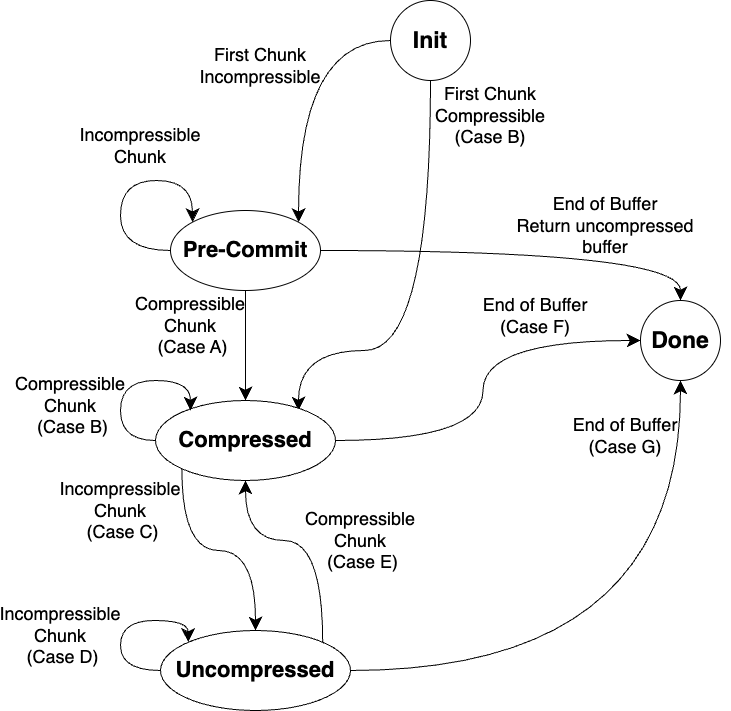
The component starts in Init and immediately moves to either the Pre-Commit or Compressed state depending on the first chunk. If the first chunk is incompressible then the state machine moves to the Pre-Commit state. In this state, the algorithm looks for chunks that are sufficiently compressible to store headers for both this first uncompressed chunk, the active compressible chunk and a final potentially uncompressible chunk. The algorithm will remain in this state so long as no sufficiently compressible chunk is found. If the end of buffer is reached in this state then the original buffer is returned unmodified and the data product will not be compressed.
When the first compressible chunk is found, the algorithm will commit to creating a compressed data product, even if this is the only compressible chunk found in the entire product. If the algorithm was previously in Pre-Commit (Case A), then uncompressed data in the first part of the buffer is moved so that a compression record can be placed in front of it, then the compressed data along with it's header is appended.
As compressible chunks are found they are appended to the buffer along with individual compression headers. The algorithm ensure that chunks are sufficiently compressed such that there is always room for a final uncompressed chunk, along with the corresponding record header for that uncompressed chunk.
The first incompressible chunk found after Pre-Commit (Case C) will generate a uncompressed record header followed by the uncompressed data. As further incompressible chunks are found (Case D) then will be appended to the existing uncompressed record, no extra headers are needed. If a compressible chunk is found, or end of the buffer is reached, the true size of the uncompressed record will be written.
This algorithm is non-trivial but allows data products, that can be fairly large, to be compressed in place.
Change Log
| Date | Description |
|---|---|
| 04/14/2026 | Initial Draft |