ComFprime Subtopology
References
- ComFprime Subtopology SDD
- F Prime Protocol SDD
- F Prime Framer SDD
- F Prime Deframer SDD
- F Prime Router SDD
- F Prime ComQueue SDD
Overview
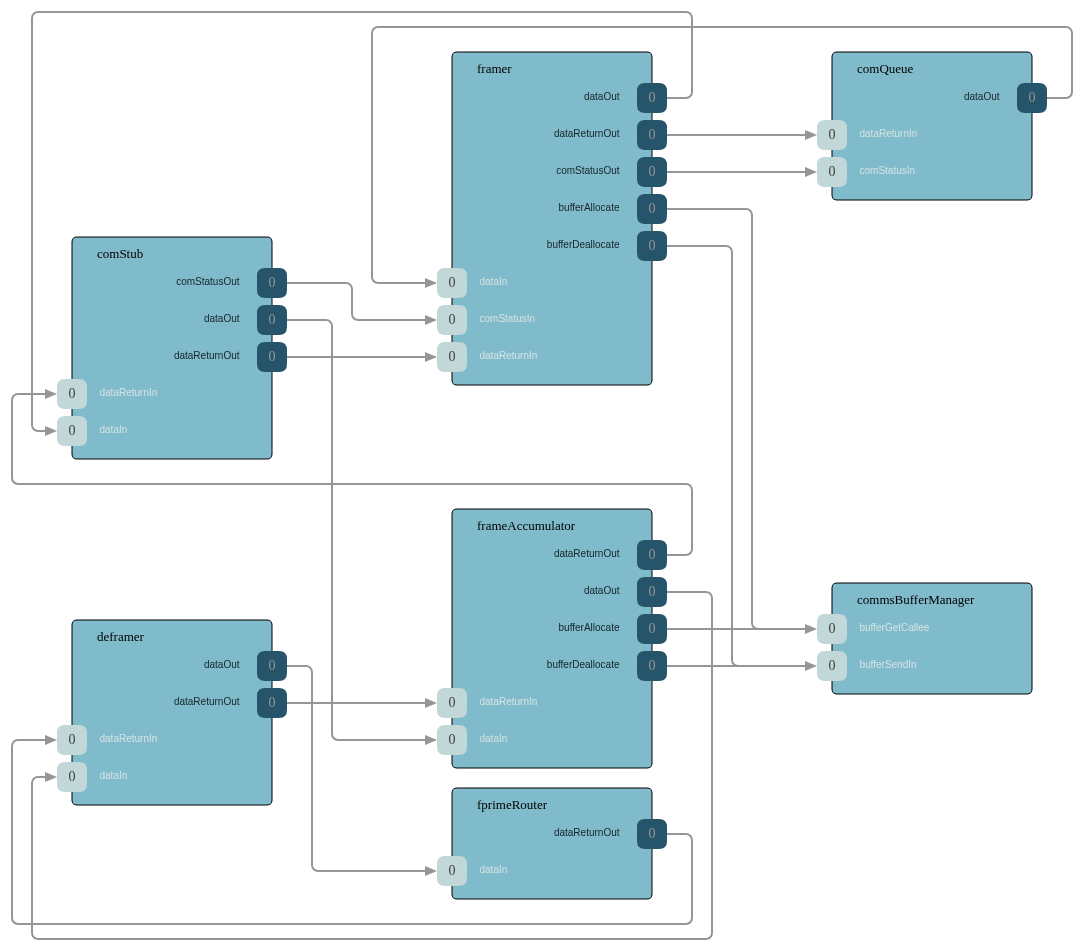
The ComFprime subtopology packages the F Prime protocol communication stack as a reusable building block. It provides the complete data path for downlink (framing outgoing packets) and uplink (deframing incoming data and routing packets to their destinations). This subtopology uses the lightweight F Prime framing protocol, which is suitable for development, testing, and missions that do not require CCSDS-standard framing.
Two variants are available:
- With ComStub — Includes a ComStub communication adapter and expects to be connected to a byte stream driver (TCP, UDP, UART). This is the simplest option for most deployments.
- With External ComInterface — Does not include a communication adapter; the deployment provides its own implementation (e.g., a radio driver). This variant is used when the communication hardware requires a custom adapter.
Topology Diagram
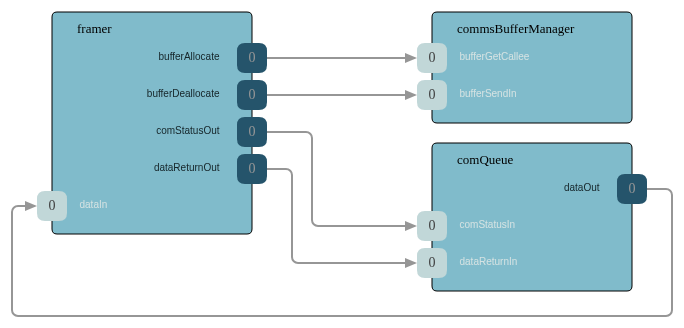
Downlink Path
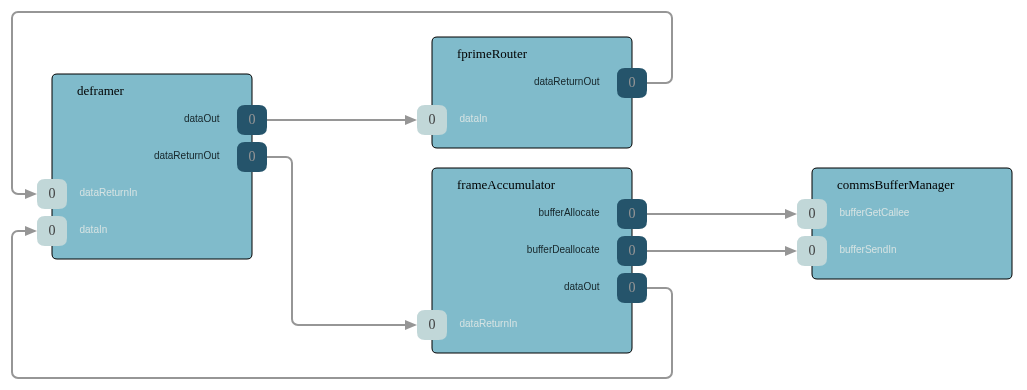
Uplink Path
Included Components
- F Prime Framer — Frames outgoing packets using the F Prime protocol (start word, size, payload, CRC).
- F Prime Deframer — Validates and extracts payloads from incoming F Prime protocol frames.
- F Prime Router — Routes deframed packets to their destination (commands to the command dispatcher, file packets to file uplink).
- Communication Queue — Queues outgoing data (telemetry, events, file packets) and sends it to the framer. Supports priority-based ordering.
- Frame Accumulator — Collects incoming byte stream data and assembles complete frames for the deframer.
- Buffer Manager — Provides buffer allocation for the communication path.
- ComStub (variant A only) — Adapts a byte stream driver to the communication interface.
Configuration
- Base IDs, queue sizes, stack sizes, priorities, and CPU affinities are configurable via ComFprimeConfig.
- The Communication Queue depth and priority levels are configurable.
Required Inputs
- A rate group connection to drive the Communication Queue's send cycle.
- A byte stream driver (variant A) or custom ComInterface implementation (variant B).
- Connections from telemetry, event, and file downlink sources to the Communication Queue.
- Connections from the router's outputs to the command dispatcher and file uplink.